Sacred and Profane Love
Dublin Core
Title
Sacred and Profane Love
Description
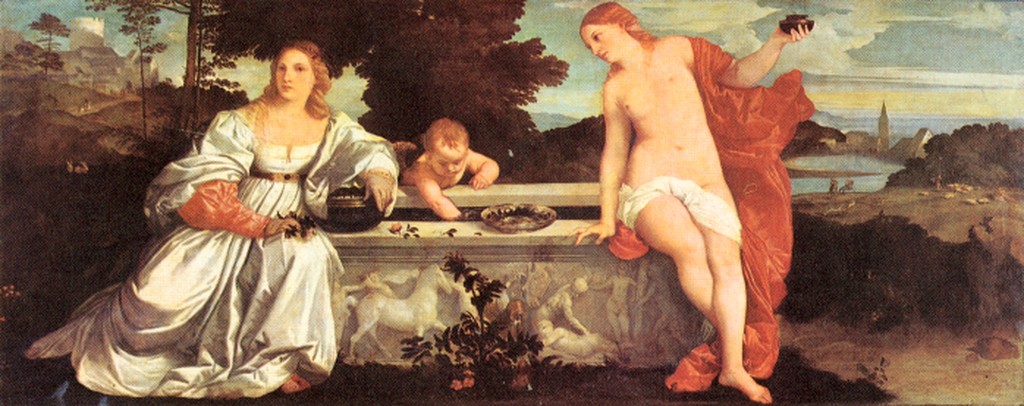
This work was done by Titian, quite early in his career. This painting is often seen as one of the most enigmatic of Italian High Renaissance works. It is assumed by many scholars that the painting was commissioned by Niccolò Aurelio, secretary of the Venice Council of Ten in order to celebrate his marriage with young widow Laura Bagarotto. [1] Two women, one being nude, are sitting on a carved antique Roman sarcophagus, located in the center of the artwork. Near the base one can see the carved coat of arms of Nicolio Aurelio. Additionally, between the two women is what appears to be a small child. The woman on the left is richly dressed and her clothes are now commonly recognized as bride clothes, and she is wearing a vivid white dress, which represents purity. In her hair, she wears a myrtle, and a flower sacred to Venus, and a flower worn by the bride. On the otherhand, the woman on the right is naked, with the exception of a large red cloth draped over. To me this seems to use the red to draw the viewer's eyes to the nude figure. Scholars have come to the conclusion that the two women represent the antithesis between, on the right, eternal values, and, on the left, temporal ones. Although there is obviously contrast, the women are still so similar, and many scholars debate whether they are sisters or even twins. The two women, child, and fountain/sarcophagus generate an aura which dominates and almost overwhelms the surrounding pastoral scene because of its centrality in the design. [2] Furthermore, the foreground and mid-ground colours are earth tone browns and greens, appearing as though struck from one another, the exception being the use of primary colours such as silver, red and white to distinguish the clothing from those surrounding colors. In the far background we see the use of blue and yellows of a clouded sky at sunset. The skin tones are pale and white, the hair partly dressed with tints of reddish golds, which we know was common for Venetian women. Overall, the meaning of the painting is ambiguous but a thorough analysis provides insight on how these women may be representing contrasting views of the same concept, whatever the concept may be. (love, marriage, etc.)
[1] “Sacred and Profane Love,” Galleria Borghese, accessed November 19, 2020, https://borghese.gallery/collection/paintings/sacred-and-profane-love.html.
[2] “Sacred and Profane Love By Titian,” accessed November 19, 2020, https://www.titian.org/sacred-and-profane-love.jsp.
[1] “Sacred and Profane Love,” Galleria Borghese, accessed November 19, 2020, https://borghese.gallery/collection/paintings/sacred-and-profane-love.html.
[2] “Sacred and Profane Love By Titian,” accessed November 19, 2020, https://www.titian.org/sacred-and-profane-love.jsp.
Creator
Titian
Source
“Sacred and Profane Love by Titian.” Galerie Borghèse, August 4, 2019. https://borghese.gallery/collection/paintings/sacred-and-profane-love.html.
"Sacred and Profane Love, 1514 by Titian." Accessed November 19, 2020. https://www.titian.org/sacred-and-profane-love.jsp.
Cantelupe, Eugene B. "Titian's Sacred and Profane Love Re-examined." The Art Bulletin 46, no. 2 (1964): 218-27. Accessed November 19, 2020. doi:10.2307/3048166.Image: Titian. c. 1515. Sacred and Profane Love. painting. Place: Galleria Borghese. https://library.artstor.org/asset/SCALA_ARCHIVES_10310195612.
Publisher
Titian. c. 1515. Sacred and Profane Love. painting. Place: Galleria Borghese. https://library.artstor.org/asset/SCALA_ARCHIVES_10310195612.
Date
1515
Contributor
Jared Kreis
Rights
(c) 2006, SCALA, Florence / ART RESOURCE, N
Format
oil on canvas, 118 x 279 cm
Type
Painting
Coverage
Galleria Borghese, Rome, Italy
Files
Citation
Titian, “Sacred and Profane Love,” ARTHIST 89S - Visual Culture of Venice - Fall 2020, accessed October 22, 2026, https://venice.dahvc.org/fall-2020/items/show/192.