Sisyphus
Dublin Core
Title
Subject
Description
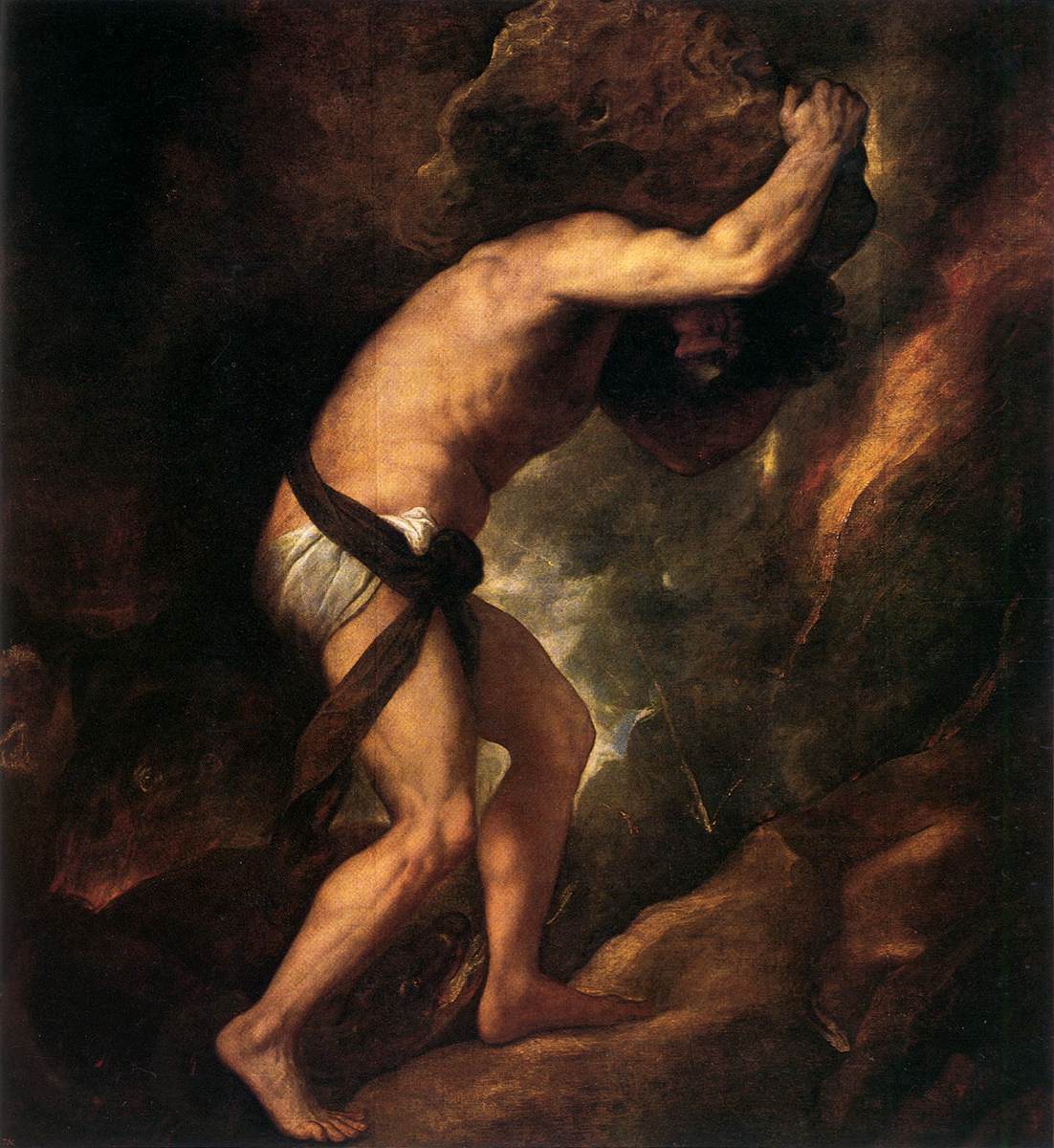
In Greek mythology, Sisyphus is the founder and first sovereign ruler of modern Corinth (which was then Ephyra). After numerous attempts to trick the gods and cheat death, the gods finally catch up to him and punish him. Sisyphus’ sentence is to roll a rock up a hill, where each time he nears the top it rolls back to the bottom so he can start again––the definition of futility to which he lends his name [1].
Despite employing a limited palette of earthy hues such as browns and grays, Titian is able to achieve a tremendous amount of depth and color––a hallmark of the Venetian emphasis on colorito. This technique casts a dull, muted light over the subject that brings a grim feeling upon the viewer. This is only added to by the rock’s shadow that casts his face in anonymity. This signals the hardship, pain, and suffering that Sisyphus is forced to endure for his sins. The intense attention to detail on the figure’s veins and muscles also underscore his strain from an eternity of physical labor.
Much like its surviving sister painting, Tityus, Sisyphus was commissioned for Mary, Queen Consort of Hungary and Bohemia to hang in the Great Hall of her Binche Palace [2]. As a myth, Sisyphus warned Greeks of how dangerous and wrong it was to resist the gods (and those who had their blessings, which more often than not meant the powerful elite). Furthermore, it pushed the idea of a universal definition of justice––one that reflected some higher moral order. Mary––who had a difficult time asserting authority as a woman in power during the 16th century––needed to send a message [3]. Placing this work in the room in which she received guests, she could do exactly that. Mary all but explicitly defined herself as a figure of justice who must never be questioned––a powerful ruler who continued the legacy of the gods of ancient Greece.
[1] Mark Morford and Robert J. Lenardon, Classical Mythology (Oxford: Oxford University Press, 1999), 491.
[2] Miguel Falomir, "The 'Furias': From Titian to Ribera," Museo del Prado, last modified 2014. https://www.museodelprado.es/en/whats-on/exhibition/the-furias-from-titian-to-ribera/5421b042-69b8-4345-8e6f-11ea4ced0823.
[3] Sharon L. Jansen, The Monstrous Regiment of Women: Female Rulers in Early Modern Europe (London, Palgrave Macmillan, 2002), 99.
Creator
Source
Falomir, Miguel. "The 'Furias': From Titian to Ribera." Museo del Prado. Last modified 2014. https://www.museodelprado.es/en/whats-on/exhibition/the-furias-from-titian-to-ribera/5421b042-69b8-4345-8e6f-11ea4ced0823.
Jansen, Sharon L. The Monstrous Regiment of Women: Female Rulers in Early Modern Europe. London: Palgrave Macmillan, 2002.
Morford, Mark; Lenardon, Robert J. Classical Mythology. Oxford: Oxford University Press, 1999.Image Source: World Gallery of Art, accessed November 17, 2020. https://www.wga.hu/html_m/t/tiziano/09/01sisyph.html.