The Adoration of the Kings
Dublin Core
Title
The Adoration of the Kings
Description
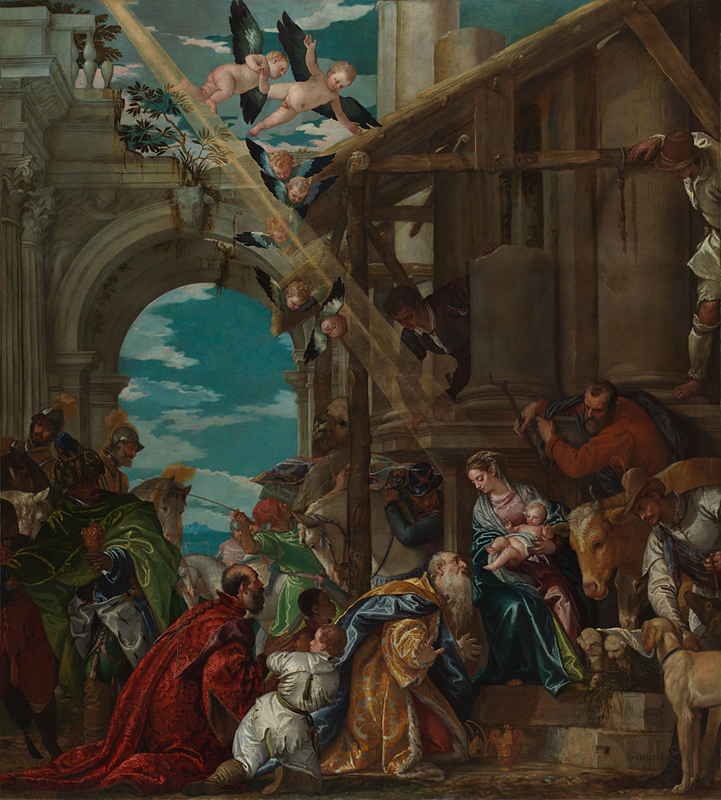
Created by Paolo Veronese c. 1573, The Adoration of the Kings depicts the biblical story of the Three Kings paying a visit to the newborn Christ in the manger. Veronese was born approximately 50 years prior, in 1528, to a small family in Verona, Italy [1]. He spent his career creating large canvases that depicted historical and biblical stories, and was known for his mastery of color, as well as his precise brushstrokes and decorative figures. Veronese came to Venice c. 1550 and immediately became involved in a long commission with decorating the Palazza Ducale – his first well-known pieces of artwork from Venice [2].
Veronese was commissioned by the Church of Saint Silvestro to create a focal piece that narrated an important biblical story when visitors and members of the church looked at the nave, or central area, of the church [3]. In the painting, Veronese shows Virgin Mary sitting to the left of the frame on a throne, holding the newborn baby Jesus. She is surrounded by a large group of people, most of whom are on their knees, looking up at Christ in awe and devotion. While Veronese strays from a traditional illustration of the manger, on Mary’s side closest to the viewer stands a cow above two sheep, and the ground appears to be discolored, possibly representing hay. When looking closely at the painting, the viewer can see the Veronese actually included several animals in the background, such as the horses and goats mixed in with the crowd of visitors of Christ. Additionally, Veronese skillfully incorporates Roman architecture into the background, depicting high arches with traditional columns, which give way to a dark, but picturesque sky – which Veronese uses to add to the viewer’s sensation of divinity in the scene. Tucked near the high arches, Veronese paints cherubs with wings circling above baby Christ, further emphasizing the miracle fo Christ.
Veronese uses a combination of various impressive skills to make this depiction of the traditional biblical story unique. Most notably, Veronese’s use of light highlights Mary and baby Christ as holy and of high importance. Similar to the traditional use of halos to show divinity, Veronese shows a single beam of light directed towards the Virgin’s throne, illuminating her and baby Christ. The rest of the painting is largely in the dark, furthering the contrast between the heavenly figures on the throne and people who are there to pay their respects. Furthermore, Veronese’s attention to detail in the clothing draws the viewer not only to Mary but the kings as well, highlighting their role in the story depicted – he paints them with bright colors and intricate patterns. As stated above, Veronese ties the scene together with both architecture, a small yet important natural background, and the various animals in the manger, all working to create harmony in a busy scene. Ultimately, Veronese’s technical choices throughout the painting allow for the viewer to truly grasp the importance of both the Virgin and Christ, and the scene as a whole.
[1] Rodolfo Pallucchini, “Paolo Veronese,” 2019, https://www.britannica.com/biography/Paolo-Veronese.
[2] Nicholas Penny, "Composition, Gesture and Meaning in an Early Painting by Veronese," Artibus Et Historiae 35, no. 70 (2014): 225-226
[3] Jill Dunkerton, Susan Foister, and Nicholas Penny, “The Altarpiece,” in Durer to Veronese: Sixteenth-Century Painting in the National Gallery (London: Yale University Press, 1999), p. 47.
Creator
Paolo Veronese
Source
Pallucchini, Rodolfo. “Paolo Veronese,” 2019. https://www.britannica.com/biography/Paolo-Veronese.
Penny, Nicholas. "Composition, Gesture and Meaning in an Early Painting by Veronese." Artibus Et Historiae 35, no. 70 (2014): 211-19.
Dunkerton, Jill, Foister, Susan, and Penny, Nicholas. “The Altarpiece.” In Durer to Veronese: Sixteenth-Century Painting in the National Gallery, 47. London: Yale University Press, 1999.
Image Source: Veronese, Paolo. The Adoration of the Kings. The National Gallery. Accessed October 27, 2020. https://www.nationalgallery.org.uk/paintings/paolo-veronese-the-adoration-of-the-kings.
Publisher
Church of Saint Silvestro, Venice
Date
1573
Contributor
Ithika Senthilnathan
Rights
Public Domain. Image Source: Veronese, Paolo. The Adoration of the Kings. The National Gallery. Accessed October 27, 2020. https://www.nationalgallery.org.uk/paintings/paolo-veronese-the-adoration-of-the-kings
Format
Oil on Canvas, 355.6 x 320.0 cm
Type
Oil on canvas painting
Coverage
The National Gallery, London, United Kingdom
Files
Citation
Paolo Veronese, “The Adoration of the Kings,” ARTHIST 89S - Visual Culture of Venice - Fall 2020, accessed October 22, 2026, https://venice.dahvc.org/fall-2020/items/show/137.