Judith
Dublin Core
Title
Subject
Description
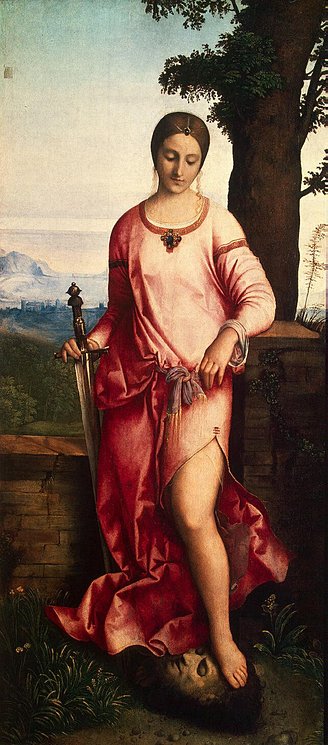
Giorgione’s Judith is a beautiful young widow who has already slain the Assyrian general Holofernes. In fifteenth and sixteenth-century Italy, Judith often served as an allegorical figure of Virtue triumphant, or as the victor in a number of binary oppositions such as the Church vs. the Ottoman Turks. Judith also served as an exempla virtutis for women – an example of the gendered qualities of obedience, humility, and chastity. She became a problematic figure at times: while she was a model of familial and civic virtue, she was also a woman who outsmarted a man and cut off his head. Some preachers and treatise writers warned that her example would lead unintelligent women to kill their husbands, and unflattering prints depicting her as a femme fatale were circulated throughout Europe.
This Judith strikes a balance between modest, virtuous woman and symbol of power. Her eyes are averted from the viewer, cast low in a gesture of humility that was typical of portraits of women at this time. Her sword is held loosely at her side, neither bloodied nor wielded high as in other images. However, the positioning of her right arm and the shading of her gown draw the eye to the split seam and her exposed leg. Judith’s bare leg, thrust forward toward the viewer and exerting pressure on Holofernes’s severed head, shows her dominance and is suggestive of the means by which she bested Holofernes. During this time, Judith’s detractors claimed that she seduced Holofernes in order to kill him, whereas her supporters insisted that she remained chaste and won her victory as the handmaiden of God. Giorgione’s rendering leaves room for either interpretation, or further, the possibility of a heroine who embodies that is both sensual and divine.
Creator
Source
- Brine, Kevin, Elena Ciletti and Henrike Lahnemann, eds. The Sword of Judith: Judith Studies Across the Disciplines. Cambridge: Open Book Publishers, 2010.
- Dal Pozzolo, Enrico Maria and Lionello Puppi, eds. Giorgione. Milan: Skira, 2009.
- Fomicieva, T. "The History of Giorgione's 'Judith' and its Restoration." Burlington Magazine 115, no. 844 (1973): 417-21.
Publisher
Date
Contributor
Format
Type
Coverage
Files