Moderata Fonte
Dublin Core
Title
Subject
Description
“I await fame and glory in life, and then in death” [1].
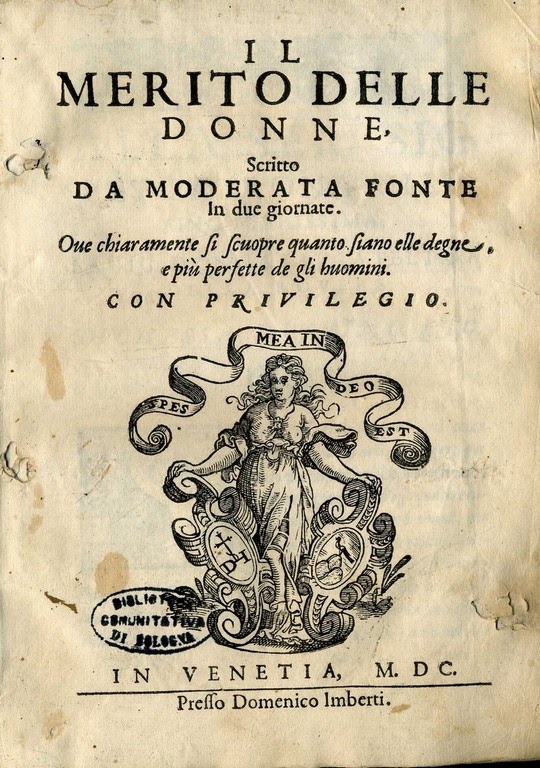
Like Tullia d’Aragona’s dialogue, Moderata Fonte’s Il merito delle donne (1600) is a commentary on the dialogues of philosophers and humanists, which were almost exclusively composed of male voices in early modern Italy. In a Venetian garden, virgins, matrons, and crones discuss the soul, knowledge, and virtues; they form a perfect female society in which women gain strength from one another and live autonomously [2]. While Fonte lauds the city of Venice, there is critique embedded in this praise: the political apparatus of Venice was an object of admiration to statesmen throughout Europe, but it remained oppressive to women [3].
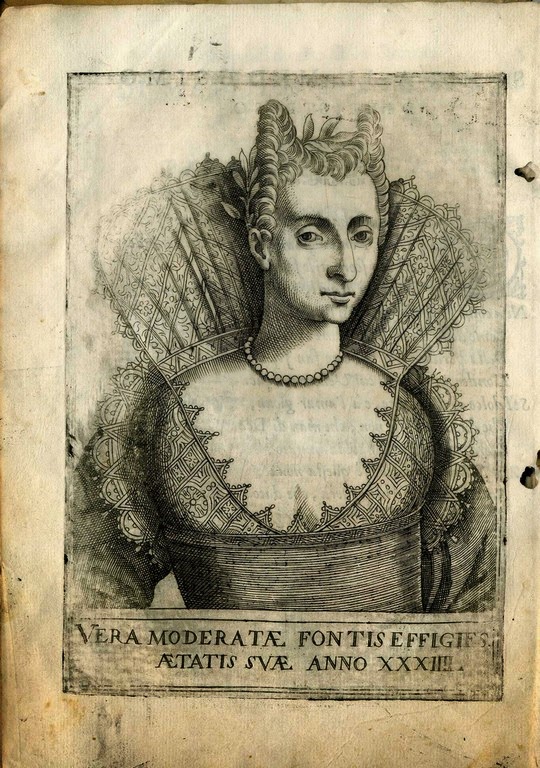
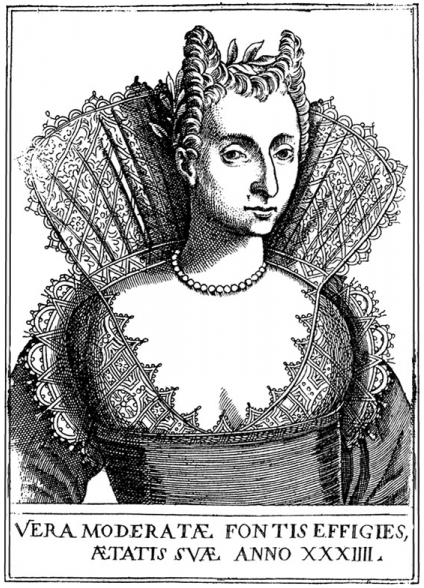
The quote above foreshadows the author’s fate: Fonte died in childbirth one day after finishing her book. Eight years after her death, two of her children submitted her book for publication, which means that the author’s portrait is a posthumous portrait. Perhaps for this reason, her portrait is less individualized than the portraits of d’Aragona and Franco. She wears a fashionable Venetian costume with a starched lace collar and a horned hairstyle that was at one time synonymous with courtesans, though noblewomen also wore it. The intricacy of the lace detailing on her gown and her pearl necklace communicate her status as a reputable lady, yet there is little that is distinct about her appearance. This woodcut print can be understood as a generic image type rather than an individualized portrait of a historic woman. One detail that distinguishes this woman from similar images is the crown of laurel leaves signifying her achievement in letters, an honorific which nearly blends in with her curls, fading from view. Notably absent are the traditional literary attributes of books, letters, or a pen. The image of the author becomes first and foremost the image of anonymized female respectability.
[1] Moderata Fonte, Il merito delle donne (Venice, 1600), 4.
[2] Margaret King, Women of the Renaissance (Chicago: University of Chicago, 1991), 228.
[3] King, Women of the Renaissance, 231.
Creator
Source
- Deslauriers, Marguerite. "Patriarchal Power as Unjust: Tyranny in Seventeenth-Century Venice." British Journal for the History of Philosophy 27, no. 4 (2019): 718-737.
- Fonte, Moderata. Il merito delle donne. Venice, 1600.
- King, Margaret. Women of the Renaissance. Chicago: University of Chicago, 1991.
Publisher
Date
Contributor
Rights
Format
Type
Coverage
Files