Browse Items (14 total)
- Collection: November 20: Galleria Borghese or Pinacoteca di Brera
Sort by:
Sacred and Profane Love

Titian painted Sacred and Profane Love in circa 1515. It was commissioned by Niccoló Aurelio in 1514, a superb chancellor in Venice's city government, on behalf of his matrimony to Laura Bagarotto of Padua [1]. In 1613, this composition was described…
Apollo and Daphne
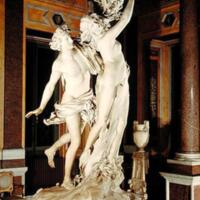
Bernini was an Italian sculptor and architect in the seventeen century. In the mature period of his career, he was also keen on city designing and theater directing, designing all their technical and visual installations by himself. He was famous for…
David with the Head of Goliath
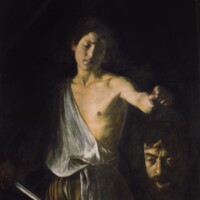
Michelangelo Caravaggio, born in Milan, mastered painting biblical stories in a dark and violent light [1]. Caravaggio created David with the Head of Goliath for Scipione Borghese, an Italian cardinal, as a way of asking for forgiveness for murdering…
David with the Head of Goliath
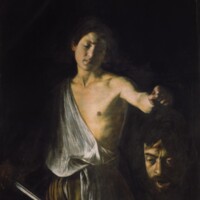
Created by Michelangelo Caravaggio c. 1606-1610, David with the Head of Goliath was created as a gift for the papal court of Rome, specifically for Scipione Borgehese. Caravaggio was accused of murdering Tomassoni in May 1606, and fled from Rome, but…
Finding of the Body of Saint Mark (Discovery of the Body of Saint Mark)
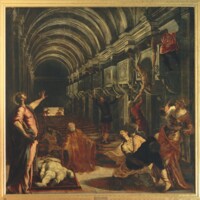
The first thing that viewer's eyes are drawn to is the larger than life man on the left hand side of the painting. He is clothed in blue and light red cloth, with one arm on his hip and one outstretched towards the center of the painting. The cloth…
Sacred and Profane Love
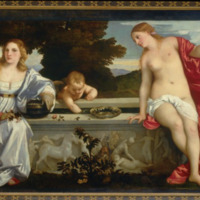
Sacred and Profane Love is a piece done by Titian circa 1515 for Niccolò Aurelio [1]. Niccolò Aurelio, secretary of the Venice Council of Ten, commissioned this painting for his marriage to Laura Bagarotto [2].
The painting itself depicts two ladies,…
Sacred and Profane Love

This early oil painting by Titian features a pastoral setting with a lake and luscious green rolling hills. To one side we can see a church with a grand steeple while the other side is flanked by a castle-like fortification overlooking a village. In…
Sacred and Profane Love

Titian’s Sacred and Profane Love made circa 1515 is an oil painting that was commissioned by Niccolò Aurelio, who was a secretary to the Venetian Council of Trent. It was made to commemorate his marriage with a young widow named Laura Bagarotto…
Saint Mark Preaching in Alexandria

In this painting, we see Saint Mark preaching in Alexandria. Giovanni and Gentile Bellini pull the focus onto the details of the landscape in multiple ways. First, with regards to the composition of the image, Bellini scattered objects of Venetian…
St. Mark Preaching in Alexandria

Upon the death of Gentile Bellini in 1507, it was prescribed in his will that his younger brother, Giovanni Bellini, would complete the work St. Mark Preaching in Alexandria commissioned by the Scuola Grande di San Marco [1]. Giovanni’s continuation…