Browse Items (16 total)
- Collection: October 7: National Gallery of Art, London (Visual Analysis)
Sort by:
Doge Leonardo Loredan
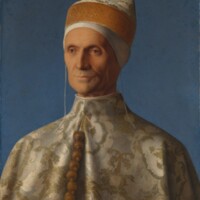
The portrait of Doge Leonardo Loredan is one of Giovanni Bellini's most famous paintings, and it is currently in the National Gallery in London, United Kingdom. Doge Leonardo Loredan ruled Venice from 1501 to 1521, and Bellini completed the painting…
St. Jerome In His Study
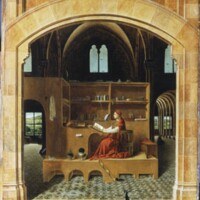
One of the first thing that sticks out at the viewer when looking at Messina's painting is the architecture that he frames the picture in. A yellow or tan limestone arch that is in the Venetian architectural style stands in front of the audience to…
Bacchus and Ariadne
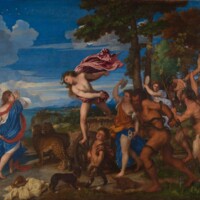
In this painting, we see Bacchus, the god of wine, leaping from his chariot towards Ariadne, who has been abandoned by her lover, to protect her from his revelers close behind. Titian highlights the central tension between Bacchus and Ariadne in…
Bacchus and Ariadne
Depicted here we see the Roman god of wine and fertility, Bacchus, jump from his chariot to meet with the Cretan princess, Ariadne, with whom he has fallen in love. Titian highlights these two figures, using a lighter shade for their skin compared…
Bacchus and Ariadne
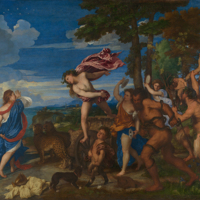
Titian is commissioned by the Duke of Ferrera, Alfonso d’Este, to create a painting for a room within the castle at Ferrara. In the early 1520’s he creates this colorful piece Bacchus and Ariadne depicting the story of its namesaske, Bacchus and…
Bacchus and Ariadne
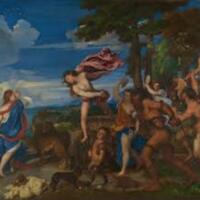
Bacchus and Ariadne, painted by Titian ca. 1520-1523, depicts the story of Bacchus, the god of wine, encountering Ariadne, the daughter of King Minos, for the first time. In the painting, we see Bacchus jumping from his chariot in such a haste that…
Bacchus and Ariadne
Titian was commissioned by the Court of Ferrara to create the Bacchus and Ariadne for placement in the Alabaster Room in the ducal palace [1]. This collection was one of the most important and highly valued at the time, since it featured works from…
Bacchus and Ariadne
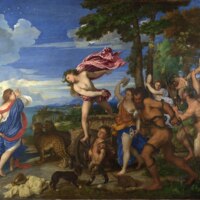
The painting Bacchus and Ariadne, created by Titian between 1520 and 1523, is a depiction of the Myth of Ariadne. Specifically, it depicts the version in the 64th poem of Catullus [2]. In the myth Ariadne, daugther of the King of Crete, helps the…
Doge Leonardo Loredan
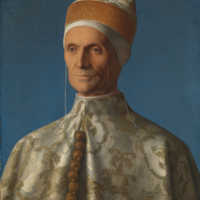
This work by Giovanni Bellini presents Doge Leonardo Loredan shortly after his election to the position [1]. It depicts him ceremoniously in elegant robes with the symbolic corno ducale on his head. Loredan is seen with a look of consternation upon…
Happy Union
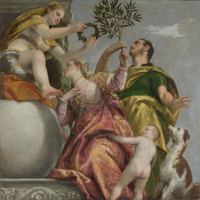
The painting of the Happy Union was most likely commissioned by a husband and wife to decorate the ceilings of their home. Veronese was chosen to create this painting, making a series called the Four Allegories of Love on the dichotomy between a…