Browse Items (177 total)
Sort by:
Venice Receiving Homage from Hercules and Ceres
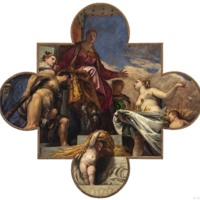
In this painting, we see a multitude of figures, some of which are in the nude whereas others are defined by idealized drapery. Immediately, the first aspect noticed is the shape of the canvas: a rectangular center with 4 semicircular lobes…
Feast in the House of Levi
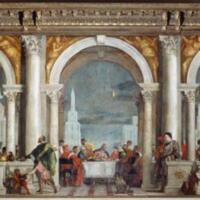
Veronese was commissioned in 1573 to paint a great banqueting picture for the convent of San Giovanni e Paolo [1]. It is a large oil painting, that now resides in the Galleria dell’Accademia in Venice. Its original name, The Last Supper, was…
Feast in the House of Levi
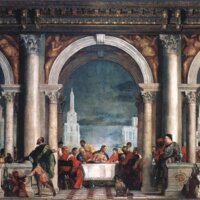
The painting Feast in the House of Levi by Paolo Veronese was made from 1571 to 1573 and today is located in the Gallerie dell'Accademia in Venice, Italy. At first, this painting was created as a replacement to Titian’s Last Supper, yet over time it…
Feast in the House of Levi
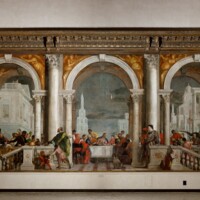
In this painting, we see a crowded banquet, replete with a multitude of Biblical figures including Jesus Christ and Judas. Veronese highlights Jesus’ holiness by using light colors and gold around his head as a halo, making his immediate surroundings…
Venice Enthroned with Justice, Peace & the Lion of St. Mark
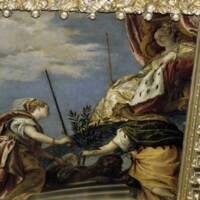
The name of this painting is called Venice Enthroned with Justice, Peace & the Lion of St. Mark. It was painted by Paolo Veronese from 1575-1576 and is painted on the ceiling of the Sala del Collegio. It is categorized under a collection with…
Venice Ruling with Justice and Peace
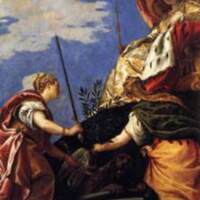
Venice, Justice, and Peace are all personified as women in this painting. Venice sits up on a throne, above Justice and Peace, dressed in expensive and stylish clothing. Venice was often personified as a maiden, as she was described so in written…
Venice Enthroned with Justice and Peace
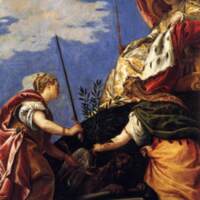
The painting Venice Enthroned with Justice and Peace is located on one of the ceilings of the Sala del Collegio in Doge Palace. As a result, you would be looking up towards this painting rather than straight ahead at it.
The image consists of…
The image consists of…
Mars and Neptune
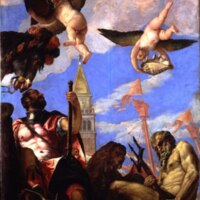
Mars and Neptune is painted by Paolo Veronese from 1575 - 1578. The Italian Renaissance painter Paolo Veronese(1528–1588) is known for the idea of opulence and splendor of Renaissance Venice that reflected in his arts. Being educated in the shadow of…
Feast in the House of Levi
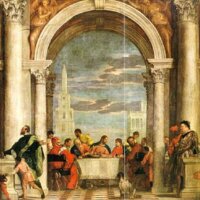
Feast in the House of Levi was a replacement for the painting of an earlier work by Titian destroyed by the fire in 1571. [1] Originally Caliari had this painting name Lord's Last Supper and intended to be a monumental artwork for a religious…
Portrait of Tullia d'Aragona as Salome
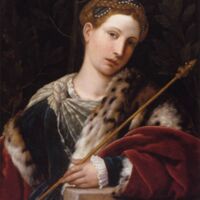
A centrally-positioned woman gazes directly at the viewer, her head cocked to the side as she reclines on a stone wall bearing an inscription. This inscription identifies one level of the figure’s identity as the biblical femme fatale Salome: "QVAE…