Browse Items (177 total)
Sort by:
Baptism of Christ
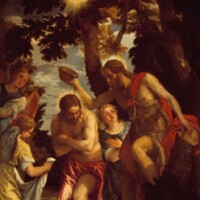
The Baptism of Christ, originally made for the Oratory of the Fiorentini Confraternity, was created by Veronese, a Venetian painter during the 16th century [1]. Paolo Veronese was born in Verona then moved to Venice to pursue his career, influenced…
Mars and Venus United by Love
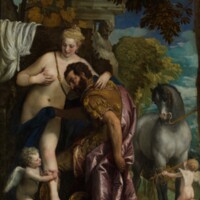
Paolo Veronese was most likely commissioned by Emperor Maximilian II to create a painting of the Roman mythological gods Venus and Mars [1]. Born in Verona (where his name stems from) to a family of artists, Veronese studied the works of those before…
Mars and Venus United by Love
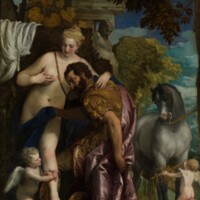
Mars and Venus United by Love was painted by Paolo Veronese (Paolo Caliari) in the 1570s. Veronese was most likely commissioned by Emperor Maximilian II to create this mythological masterpiece. Before the Metropolitan Museum of Art received this…
The Adoration of the Kings
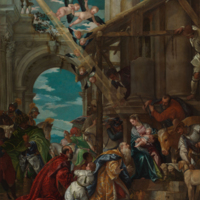
Paolo Veronese was commissioned to paint The Adoration of the Kings by the Church of Saint Silvestro in Venice because the church wanted a painting for the nave of the building [1]. Born in 1528 to a family of stonecutters in Verona, Paolo made a…
Happy Union
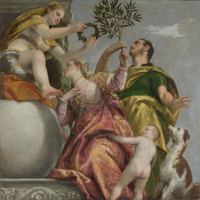
The painting of the Happy Union was most likely commissioned by a husband and wife to decorate the ceilings of their home. Veronese was chosen to create this painting, making a series called the Four Allegories of Love on the dichotomy between a…
Minerva Sending Away Mars from Peace and Prosperity
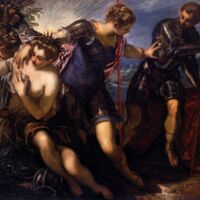
Jacopo Tintoretto was an Italian painter born in Venice whose art was characterized by uniqueness in composition and handling. His painting “Minerva Sending Away Mars from Peace and Prosperity” is part of a group of four extraordinary square…
Saint John the Evangelist on Patmos
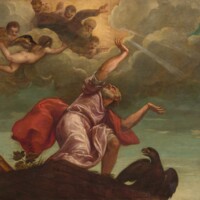
In this painting by Titian, we see Saint John on the peak of a mountain astounded and in awe at the vision of God that appears to him. This occurs following his exile from Rome by Domition in a wave of anti-Christian persecutions [1]. Our sight is…
Saint John the Evangelist on Patmos
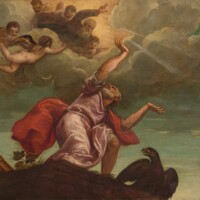
This painting was commissioned to Titian in 1544 for the new albergo (board room). This one of the wealthiest religious confraternities in Venice, stated in the National Gallery of Art article. This painting was one of four original scuole grandi.…
Bacchus and Ariadne
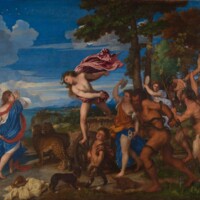
In this painting, we see Bacchus, the god of wine, leaping from his chariot towards Ariadne, who has been abandoned by her lover, to protect her from his revelers close behind. Titian highlights the central tension between Bacchus and Ariadne in…
Bacchus and Ariadne
Depicted here we see the Roman god of wine and fertility, Bacchus, jump from his chariot to meet with the Cretan princess, Ariadne, with whom he has fallen in love. Titian highlights these two figures, using a lighter shade for their skin compared…