Browse Items (177 total)
Sort by:
Bacchanal of the Andrians (Bacchinal at Andros)
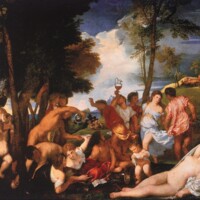
Titian paints his image with vibrant warm colors and darker cool colors. The one exception to this is the color of the sky in some areas and a woman's dress, which are both a light shade of blue. The painting has a vast amount of contrast across the…
Happy Union
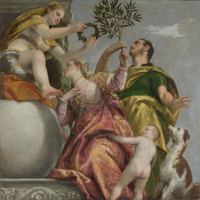
The painting of the Happy Union was most likely commissioned by a husband and wife to decorate the ceilings of their home. Veronese was chosen to create this painting, making a series called the Four Allegories of Love on the dichotomy between a…
Saint Jerome in his Study
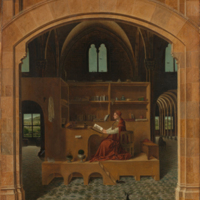
This painting is painted by Antonello da Messina depicting a scene of Saint Jerome in his study space by offering a scope into the saint’s living space as we are looking into a doll’s house. St. Jerome was born in the fourth century, he is known for…
Paradise
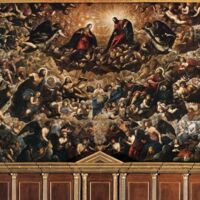
The painting Paradise, made by Jacopo and Dominico Tintoretto from 1588-1592, is featured in the Ducal Palace and represents the greatness of Venice during this time period. It is featured across the expanse of the Great Council wall and stands above…
The Death of Actaeon
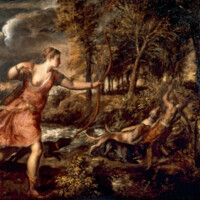
The Death of Actaeon was a piece in a large mythological series created for King Phillip II, the son of King Charles and the king of Spain [1]. “Poesie”, the other name for this particular cycle, was painted by the world-renown painter Titian. [2]…
Saint Jerome Reading
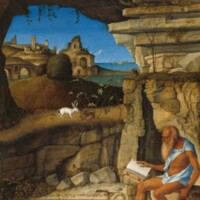
Giovanni Bellini was an Italian painter born in 1430 whose art represented stylistic innovations and concerns going on during the Renaissance [1]. He is known as one of the most influential Venetian paintings and through his career, there was an…
The Tempest
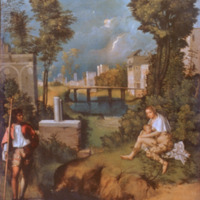
The Tempest is one of Giorgione’s few paintings and most enigmatic as there are over thirty identified interpretations ranging from biblical to Venetian [1]. Giorgione was commissioned circa 1510 to make this painting for the wealthy Venetian,…
Saint John the Evangelist on Patmos
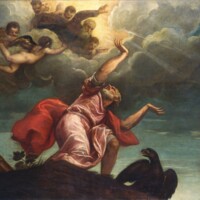
In this painting, we see Saint John the Evangelist on the island of Patmos reacting to the vision and voice of God. Titian highlights the heavenly calling in multiple ways. First, with regards to the composition of the image, although Saint John is…
The Virgin and Child between Saints Anthony of Padua and Roch
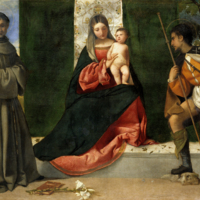
For a period the work was attributed to Giorgone, but in 1904 it was then changed and attributed to Titian by scholar Wilhelm Schmidt [1]. While some scholars still disagree, most conclude Titian was the original author but took inspiration from…
Saint Christopher
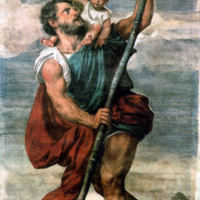
This painting is extraordinary because it survived two extreme fires of the Ducal Palace in 1574 and 1577. Titian created it in 1524, and it is currently in the Ducal Palace, over the staircase leading to the Doge's private apartment. There are few…