Browse Items (177 total)
Sort by:
The Vision of St. Augustine
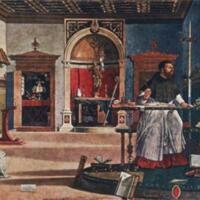
Carpaccio’s "The Vision of St. Augustine" depicts St. Augustine in his cell writing a letter to St. Jerome to try to quantify the exact amount of joy that a person feels in the presence of God. In the moment that is painted, a bright light with the…
The Worship of Venus
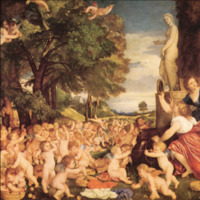
Titian, a highly revered artist of the Venetian Renaissance, was commissioned by Alfonso I d’Este the Duke of Ferrara to work on a series of paintings for the Alabaster Chamber. The collection had a Dionysian theme and included The Worship of Venus,…
Tityus
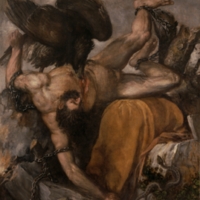
Tityus, sometimes spelled Tityos, is a giant from ancient Greek mythology and the illegitimate son of Zeus and Elara. After attempting to rape Leto, he is killed by the gods Artemis and Apollo and sent to eternal damnation in the depths of the Greek…
Triumph of Saint George (Saint George Kills the Dragon at Selene)
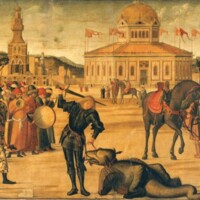
The painting Triumph of Saint George by Vittore Carpaccio is the fifth of seven paintings in a collection known as Episodes from the Life of Sts Jerome, George and Triphun that depict three stories of Christian saints. This specific painting depicts…
Venice Receiving Homage from Hercules and Ceres
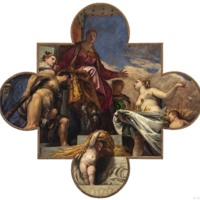
In this painting, we see a multitude of figures, some of which are in the nude whereas others are defined by idealized drapery. Immediately, the first aspect noticed is the shape of the canvas: a rectangular center with 4 semicircular lobes…
Venus and Adonis
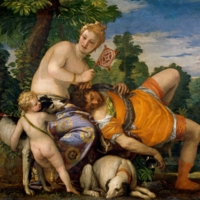
In this painting, we see Venus--the Roman goddess of love and affection--depicted with blonde hair, draped with a fine and elegant fabric from the waist down. In her lap lies Adonis, an adept hunter in Greco-Roman mythology who dons bright and…
Venus Blindfolding Cupid
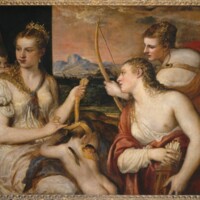
There have been several different interpretations of who the three female figures in this work are, and what they mean. At one point, it was identified as the Three Graces, but later the main figure was identified as Venus, blindfolding her son Cupid…
Venus of Urbino
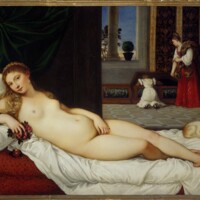
Venus of Urbino, created by Titian, shows a nude woman lounging on a bed in the foregound of the painting. Besides this figure, there are several other symbolic elements with significance [1]. One of these is the bouquet of roses she holds in her…
Venus of Urbino
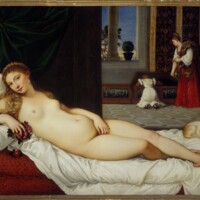
The oil on canvas painting was commissioned for Guidobaldo II, who was designated one year later as the duke of Urbino [1]. Contrary to the description provided by the title, the primary subject matter of the image is a representation of an Italian…
Mars and Venus United by Love
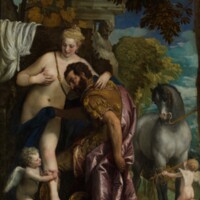
Paolo Veronese was most likely commissioned by Emperor Maximilian II to create a painting of the Roman mythological gods Venus and Mars [1]. Born in Verona (where his name stems from) to a family of artists, Veronese studied the works of those before…