Browse Items (177 total)
Sort by:
David with the Head of Goliath
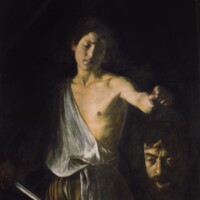
Michelangelo Caravaggio, born in Milan, mastered painting biblical stories in a dark and violent light [1]. Caravaggio created David with the Head of Goliath for Scipione Borghese, an Italian cardinal, as a way of asking for forgiveness for murdering…
Danaë
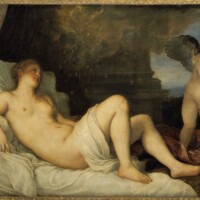
In this painting Titian exhibits his use of colorito, which is when color is used in a dominating manner in the work. The color helps depict the story of the painting, which involves Jupiter seducing Danaë. The story explains how Danaë was locked in…
Danaë
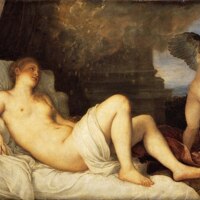
The painting Danaë, by Titian, was made in 1544 and is located in the Capodimonte Museum in Naples, Italy. The painting was made for Cardinal Alessandro Farnese’s bedroom and is representative of his own mistress. The painting was made for the…
Danaë

Painted by Titian c. 1544, this version of Danaë was his first of many renditions of this scene, and is widely regarded as one of the most sensual paintings of the Italian Renaissance. Titian depicts the princess Danaë being impregnated by the Greek…
Danaë (with Cupid)
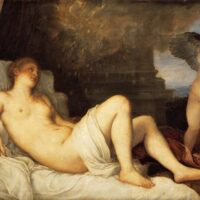
Titian, known as the greatest Italian Renaissance painter of the Venetian school, was known for penetrating human character in his canvases. In many of his paintings, he carefully represented physical beauty and a level of eroticism that has not been…
Corisca and the Satyr
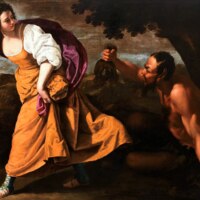
In this painting, we see a young woman fleeing a satyr seated upon the ground. Gentileschi highlights Corisca's movement through the figure's spatial dominance of the picture plane and her billowing garments with highly articulated drapery. Her…
Christ Carrying the Cross
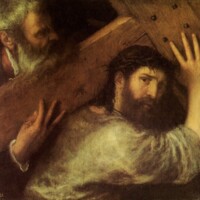
Titian’s Christ Carrying the Cross was not a one off subject matter or commission. Several decades prior Titian had created a version of Christ Carrying the Cross depicting Christ tied at the neck by the rope of an executioner [1]. This work was…
Castelfranco Madonna
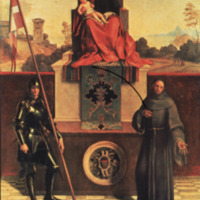
Castelfranco Madonna is an altarpiece commissioned by Tuzio Constanzo, a condottierio or warlord, and was made in memory of his son, Matteo, who had passed away most likely while serving under his father in war [1]. The Madonna is featured while…
Cameria, or Mihrimah Sultan as Saint Catherine
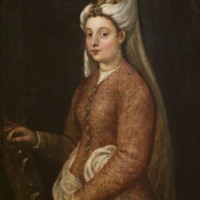
Cameria, the daughter of Suleiman the Magnificent, faces the viewer in a three-quarter pose, her expression still and confident as she makes direct eye-contact. Her left hand rests lightly on the wheel of Saint Catherine of Alexandria, a choice that…
Baptism of Christ
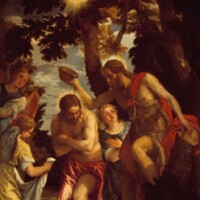
The Baptism of Christ, originally made for the Oratory of the Fiorentini Confraternity, was created by Veronese, a Venetian painter during the 16th century [1]. Paolo Veronese was born in Verona then moved to Venice to pursue his career, influenced…