Browse Items (177 total)
Sort by:
Christ Carrying the Cross
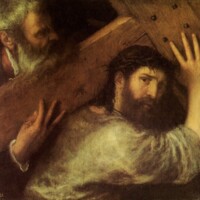
Titian’s Christ Carrying the Cross was not a one off subject matter or commission. Several decades prior Titian had created a version of Christ Carrying the Cross depicting Christ tied at the neck by the rope of an executioner [1]. This work was…
Bacchus and Ariadne
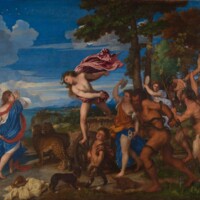
Titian was commissioned by the Court of Ferrara to create the Bacchus and Ariadne for placement in the Alabaster Room in the ducal palace [1]. This collection was one of the most important and highly valued at the time, since it featured works from…
Cameria, or Mihrimah Sultan as Saint Catherine
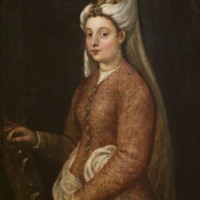
Cameria, the daughter of Suleiman the Magnificent, faces the viewer in a three-quarter pose, her expression still and confident as she makes direct eye-contact. Her left hand rests lightly on the wheel of Saint Catherine of Alexandria, a choice that…
Venus of Urbino
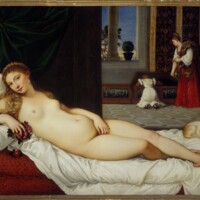
The oil on canvas painting was commissioned for Guidobaldo II, who was designated one year later as the duke of Urbino [1]. Contrary to the description provided by the title, the primary subject matter of the image is a representation of an Italian…
Venus Blindfolding Cupid
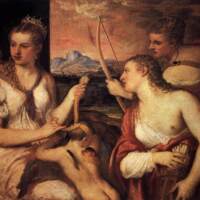
In this painting, the three main figures are the Three Graces. Some identify them as Venus and the two nymphs. There are baby cupids around them too. This work of art depicts Venus blindfolding one of the baby cupids. One of the nymphs is holding a…
Sacred and Profane Love
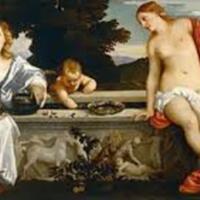
Titian’s Sacred and Profane Love made circa 1515 is an oil painting that was commissioned by Niccolò Aurelio, who was a secretary to the Venetian Council of Trent. It was made to commemorate his marriage with a young widow named Laura Bagarotto…
Sacred and Profane Love
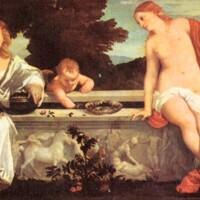
This work was done by Titian, quite early in his career. This painting is often seen as one of the most enigmatic of Italian High Renaissance works. It is assumed by many scholars that the painting was commissioned by Niccolò Aurelio, secretary of…
Venus Blindfolding Cupid
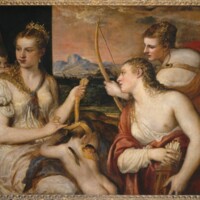
There have been several different interpretations of who the three female figures in this work are, and what they mean. At one point, it was identified as the Three Graces, but later the main figure was identified as Venus, blindfolding her son Cupid…
Sisyphus
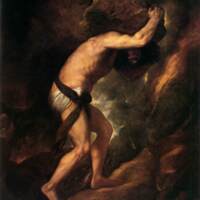
In Greek mythology, Sisyphus is the founder and first sovereign ruler of modern Corinth (which was then Ephyra). After numerous attempts to trick the gods and cheat death, the gods finally catch up to him and punish him. Sisyphus’ sentence is to roll…
Sacred and Profane Love
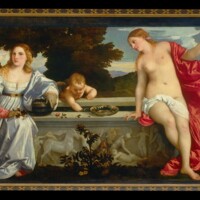
Titian painted Sacred and Profane Love in circa 1515. It was commissioned by Niccoló Aurelio in 1514, a superb chancellor in Venice's city government, on behalf of his matrimony to Laura Bagarotto of Padua [1]. In 1613, this composition was described…