Browse Items (177 total)
Sort by:
Venus of Urbino
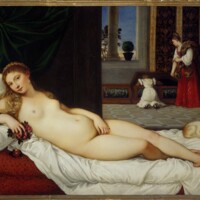
Venus of Urbino, created by Titian, shows a nude woman lounging on a bed in the foregound of the painting. Besides this figure, there are several other symbolic elements with significance [1]. One of these is the bouquet of roses she holds in her…
Flora
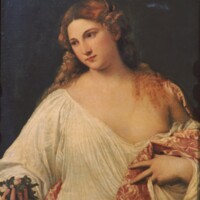
Depicted here we see Flora, the Greek goddess of Spring and the bride of Zephyr, emerging from a dark background and identified through the various flowers in her hand. While her surroundings remain dark, her figure emanates from the darkness,…
Danaë
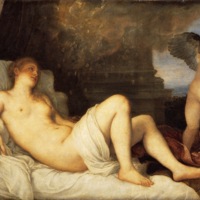
Painted by Titian c. 1544, this version of Danaë was his first of many renditions of this scene, and is widely regarded as one of the most sensual paintings of the Italian Renaissance. Titian depicts the princess Danaë being impregnated by the Greek…
Danaë with Cupid
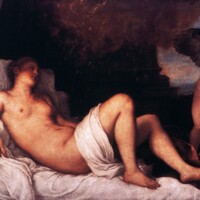
The Danaë with Cupid by Titian is the earliest version of this painting, and it was created in 1545-46. The Danaë with Cupid was a commission for Cardinal Farnese, and he did not seem too worried about the ecclesiastical office interfering with his…
Portrait of the Vendramin Family

In 1546 Titian created a magnificent group portrait of the men in the Vendramin family. This portrait was also commissioned by this family too. On the right side of the painting, there are three young men kneeling. The boys were added at a later date…
Pope Paul III with his Grandsons
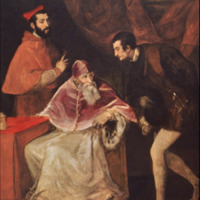
This unfinished work by Titian––Pope Paul III with his Grandsons––is a testament to the legacy of the commissioning Farnese family of Italy [1]. In this work, a frail and decrepit old man sits on a chair flanked by two younger members of his family.…
Danaë
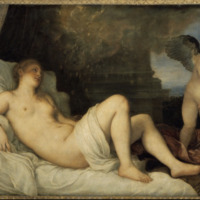
This painting, Danaë, was done by Titian in 1544 for the Cardinal Alessandro Farnese. Many more versions of this subject by Titian exist, however this was Titian’s first rendition of Danaë and it now resides in the Museo di Capodimonte [1]. It was…
Saint Christopher
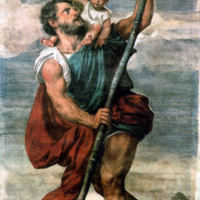
This painting is extraordinary because it survived two extreme fires of the Ducal Palace in 1574 and 1577. Titian created it in 1524, and it is currently in the Ducal Palace, over the staircase leading to the Doge's private apartment. There are few…
Saint John the Evangelist on Patmos
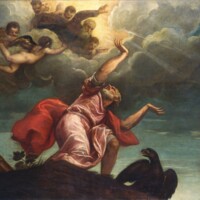
In this painting, we see Saint John the Evangelist on the island of Patmos reacting to the vision and voice of God. Titian highlights the heavenly calling in multiple ways. First, with regards to the composition of the image, although Saint John is…
The Death of Actaeon
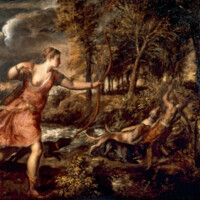
The Death of Actaeon was a piece in a large mythological series created for King Phillip II, the son of King Charles and the king of Spain [1]. “Poesie”, the other name for this particular cycle, was painted by the world-renown painter Titian. [2]…