Browse Items (177 total)
Sort by:
The Miracle of the Slave
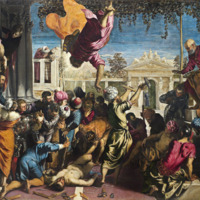
Jacopo Tintoretto was commissioned by the Scuola Grande di San Marco in 1547 to create a painting for the Sala Capitolare [1]. The artist came from a family of cloth dyers in Venice. He practiced drawing and painting from a young age, landing a spot…
The Golden Age
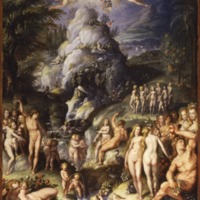
The Golden age is part of a cycle of three paintings in the Uffizi, including the other two representations of the Ages of Silver, and Iron. The cause or context the cycle of Zucchi was commissioned is not known based on the limited historic…
Allegory of Chastity
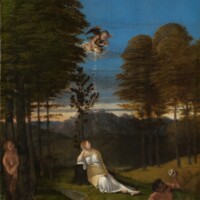
The painting of the Allegory of Chastity was originally created as a portrait cover for the bishop of Treviso, Bernardo de' Rossi. At the time, the bishop created a close-knit group of artists that he utilized to create works of art, which included…
Portrait of Bishop Bernardo de’ Rossi
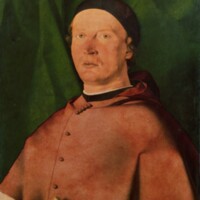
Lorenzo Lotto was commissioned to create a portrait for the Bishop Bernardo de’ Rossi that showed his elegance and status. Lorenzo Lotto, born in Venice in 1480, learned how to paint with the Murano school, as Henry S. Francis points out, working on…
Self-portrait of Marietta Robusti
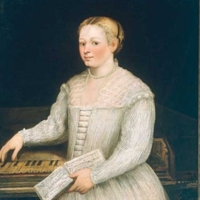
In this portrait – believed to be a self-portrait of Marietta Robusti – the sitter gazes outward at the audience with a slight smile. Turned in a three-quarter pose toward the spinet, her left hand floats above the keys as if surprised by the viewer…
David with the Head of Goliath
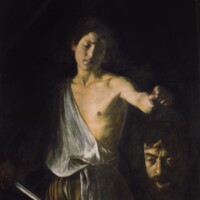
Michelangelo Caravaggio, born in Milan, mastered painting biblical stories in a dark and violent light [1]. Caravaggio created David with the Head of Goliath for Scipione Borghese, an Italian cardinal, as a way of asking for forgiveness for murdering…
David with the Head of Goliath
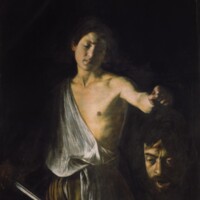
Created by Michelangelo Caravaggio c. 1606-1610, David with the Head of Goliath was created as a gift for the papal court of Rome, specifically for Scipione Borgehese. Caravaggio was accused of murdering Tomassoni in May 1606, and fled from Rome, but…
Portrait of Tullia d'Aragona as Salome
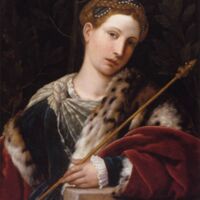
A centrally-positioned woman gazes directly at the viewer, her head cocked to the side as she reclines on a stone wall bearing an inscription. This inscription identifies one level of the figure’s identity as the biblical femme fatale Salome: "QVAE…
Feast in the House of Levi
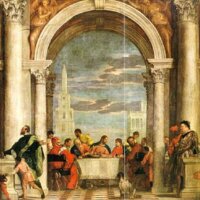
Feast in the House of Levi was a replacement for the painting of an earlier work by Titian destroyed by the fire in 1571. [1] Originally Caliari had this painting name Lord's Last Supper and intended to be a monumental artwork for a religious…
Mars and Neptune
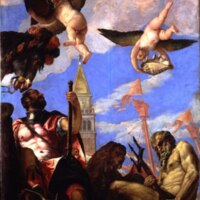
Mars and Neptune is painted by Paolo Veronese from 1575 - 1578. The Italian Renaissance painter Paolo Veronese(1528–1588) is known for the idea of opulence and splendor of Renaissance Venice that reflected in his arts. Being educated in the shadow of…