Browse Items (177 total)
Sort by:
Judith

Giorgione’s Judith is a beautiful young widow who has already slain the Assyrian general Holofernes. In fifteenth and sixteenth-century Italy, Judith often served as an allegorical figure of Virtue triumphant, or as the victor in a number of binary…
Portrait of a Young Man (or Portrait of a Gentleman in His Study)

Although the name and identity information of the young man in the portrait is not recorded, the objects placed around the characters provide clues to the audience to trace and decipher his secrets. Just like the painter's consistent style, Lotto…
Plaque with the Personification of Africa (?)
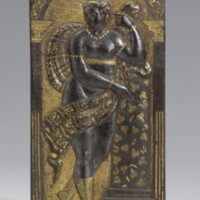
The ebony, semi-nude body of a woman emerges from a gold ground, positioned in a decorative niche as an allegorical figure. She is in motion, with one foot lifted as she stands in contrapposto, one arm raised to grasp a loop of billowing drapery near…
St. Jerome In His Study
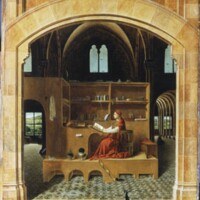
One of the first thing that sticks out at the viewer when looking at Messina's painting is the architecture that he frames the picture in. A yellow or tan limestone arch that is in the Venetian architectural style stands in front of the audience to…
Saint Jerome in his Study
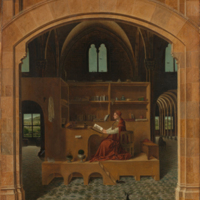
This painting is painted by Antonello da Messina depicting a scene of Saint Jerome in his study space by offering a scope into the saint’s living space as we are looking into a doll’s house. St. Jerome was born in the fourth century, he is known for…
Portrait of a Lady (Veronica Gambara)
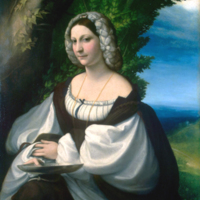
In a pastoral setting of a symbolic laurel and a changeable blue sky, the poet is placed in the imaginary domain of her works. With a half-smile, she turns toward the viewer from her three-quarter pose, apparently seated on the grass or perhaps a log…
Ponte di Rialto
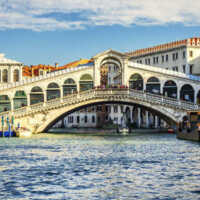
This bridge, one of four that traverse the Grand Canal, is an icon of Venice and offers quick passage to the city's main financial district Rialto. The bridge itself is a stone-arch with three lanes and two rows of shops.
Scala dei Giganti
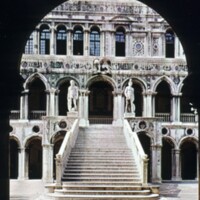
The Scala dei Giganti, which is depicted, is an entrance to the Doge’s Palace. Made of limestone and marble, this staircase is one of many representations of Venetian power and wealth. Although the staircase itself was commissioned to Antonio Rizzo,…
Corisca and the Satyr
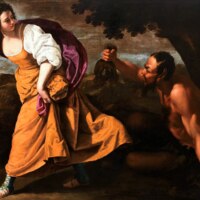
In this painting, we see a young woman fleeing a satyr seated upon the ground. Gentileschi highlights Corisca's movement through the figure's spatial dominance of the picture plane and her billowing garments with highly articulated drapery. Her…
Moderata Fonte
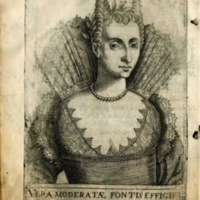
“I await fame and glory in life, and then in death” [1].
Like Tullia d’Aragona’s dialogue, Moderata Fonte’s Il merito delle donne (1600) is a commentary on the dialogues of philosophers and humanists, which were almost exclusively composed of male…