Sisyphus
Dublin Core
Title
Sisyphus
Description
Titian, one of the most important members of the 16th century Venetian school, was an Italian painter during the Renaissance [1]. Titian was famous for his drastic use of color, where he used calculated brushwork and subtle tone to spread his artistic message. Titian said that his finest works were mythologic narratives, which he compared to visual poetry [1].
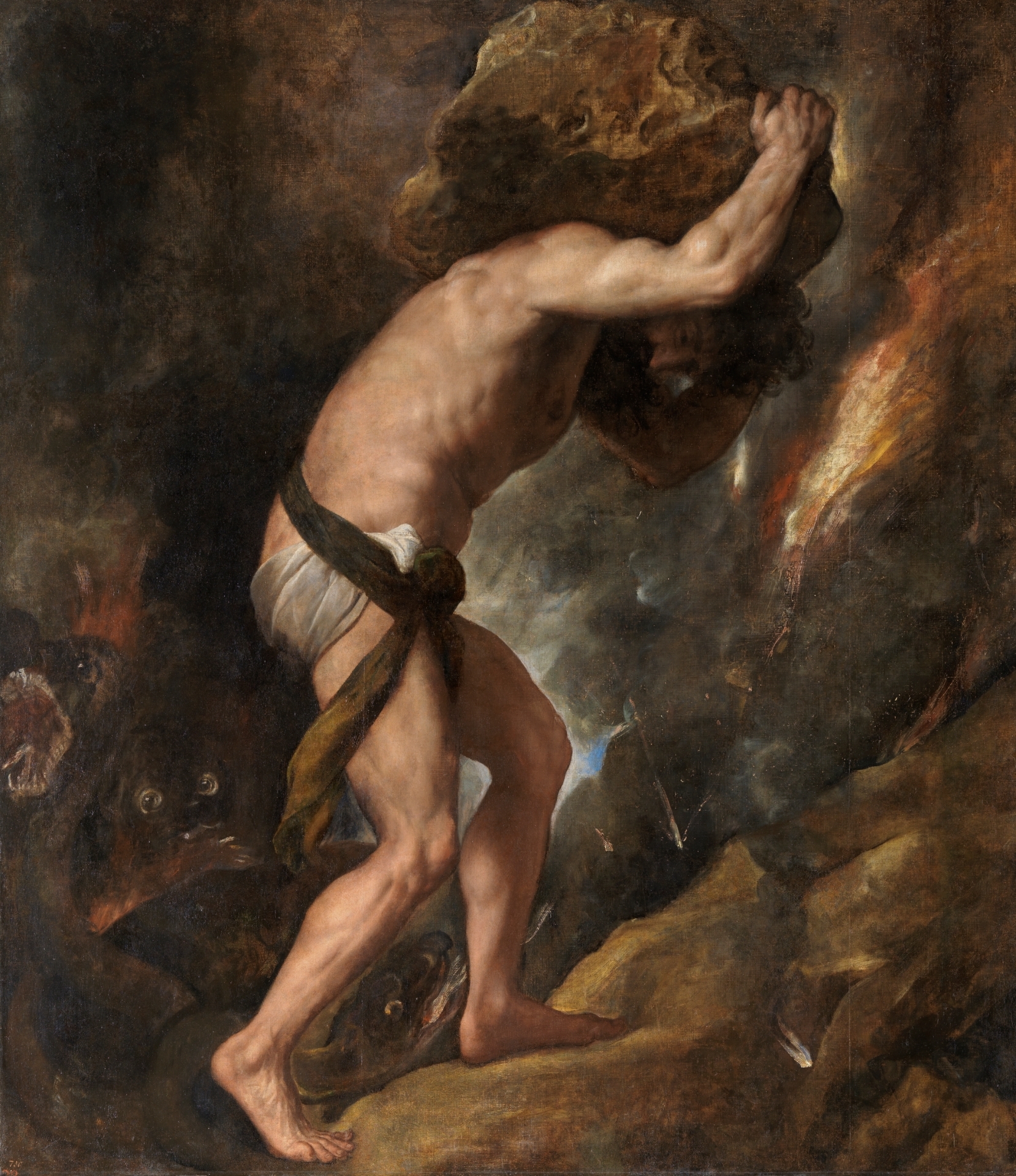
Titian’s painting Sisyphus is a prime example of one of these mythologic narratives. Sisyphus is a Greek mythological figure who was the king of Corinth and was known for being avaricious and deceitful. For this reason, he was punished by Zeus and had an eternal punishment of rolling an incredibly heavy boulder continuously up a mountain in Hades [2]. It is this myth that Titian is portraying on his magnificent campus. In this painting, Titian focuses on the anatomy of Sisyphus and the environment that he has to live in due to his punishment. The brushstrokes carefully highlight the tone in Sisyphus’s muscles showing how tired his body is as it has to endure a constant fight with a boulder. The subtle lines that emphasize Sisyphus’s rib cage and other muscles like his biceps hint that he is being starved and put in terrible circumstances [3]. The snarling demon figures and bright flames in the bottom left of the canvas place Sisyphus in a hell-like environment. The use of dark color hues throughout the background show that Sisyphus is in a deep abyss that houses him as a prisoner (it is said that Sisyphus was sent to Tartarus). While Titian emphasizes the muscularity and body of Sisyphus in his painting, he takes a different approach when it comes to portraying Sisyphus’s face. At first glance, Sisyphus’s face may not even be noticeable, but it is being pushed down by the heavy boulder on his back. The lack of color around Sisyphus’s face demonstrate how Sisyphus is a shell of his former self and is now basically a machine constantly enduring suffering. The lack of emphasis on Sisyphus’s face creates this lasting effect that he is defeated and conquered [3].
The Myth of Sisyphus teaches us to never try to escape from failures or we will have a persistent struggle against life [2]. In this painting, Titian demonstrates this constant struggle and the toll it takes on one’s life through his portrayal of The Myth of Sisyphus.
[1] Wethey, Harold, “Titian,” Encyclopedia Britannica, 1, 2
[2] Brooks, Kyle, “Conclusion: Our Pedagogical Task,” Journal of Feminist Studies in Religion 36, 189-191
[3] Mcgill, Jai, “Sisyphus, 1548 by Titian,” Titian.org, 1
Creator
Titian
Source
Wethey, Harold. “Titian.” Encyclopædia Britannica. Encyclopædia Britannica, inc., August 23, 2020. Accessed October 20, 2020. https://www.britannica.com/biography/Titian.
Nichols, Tom. "The Master as Monument: Titian and His Images." Artibus Et Historiae 34, no. 67 (2013): 219-38. Accessed October 20, 2020. http://www.jstor.org/stable/23510252.
Brooks, Kyle E. "Conclusion: Our Pedagogical Task." Journal of Feminist Studies in Religion 36, no. 1 (2020): 189-91. Accessed October 20, 2020. doi:10.2979/jfemistudreli.36.1.22.
Mcgill, Jai. Sisyphus, 1548 by Titian. Titian.org, January 14, 2011. Accessed October 20, 2020. https://www.titian.org/sisyphus.jsp.
Titian. “Sisyphus, 1548 - 1549 - Titian.” www.wikiart.org, January 1, 1970. Accessed October 20, 2020. https://www.wikiart.org/en/titian/sisyphus-1549.
Publisher
Image Source:
Titian. “Sisyphus, 1548 - 1549 - Titian.” www.wikiart.org, January 1, 1970. Accessed October 20, 2020. https://www.wikiart.org/en/titian/sisyphus-1549.
Titian. “Sisyphus, 1548 - 1549 - Titian.” www.wikiart.org, January 1, 1970. Accessed October 20, 2020. https://www.wikiart.org/en/titian/sisyphus-1549.
Date
1548-1549
Contributor
Raj Kumar
Rights
Public Domain on Wikiart
Format
Oil on Canvas, 237 cm x 216 cm
Type
Painting
Coverage
Museo Nacional Del Prado, Madrid, Spain
Collection
Citation
Titian, “Sisyphus,” ARTHIST 89S - Visual Culture of Venice - Fall 2020, accessed October 22, 2026, https://venice.dahvc.org/fall-2020/items/show/112.