Sisyphus
Dublin Core
Title
Description
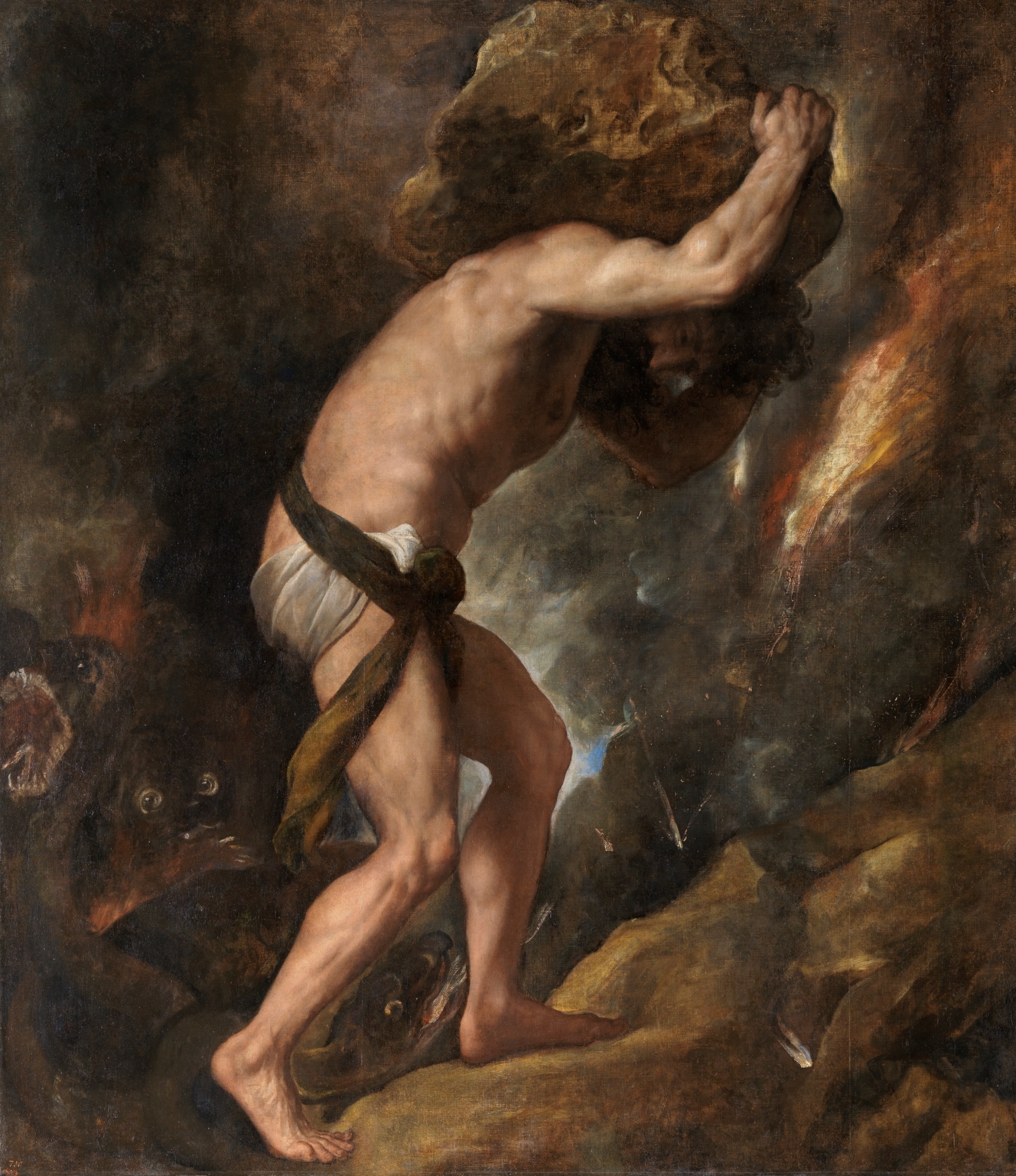
Sisyphus is a painting that depicts an old Greek myth. It was painted by Titian, who completed numerous commissions for mythological paintings including Bacchus and Ariadne, Diana and Actaeon, and the work discussed here, Sisyphus [1].
The myth of Sisyphus has varied some over time [2], but late legends say that Sisyphus was punished in the afterlife for chaining Death, so no one would die, and subsequently cheating death a second time by asking his wife to not bury him properly so that he could escape the underworld. After he died the second time, he was punished by Hades, god of the Underworld, to roll a boulder up a hill for all time [3]. This is the scene that is included in every version of the myth and is the one Titian chose to depict.
This painting is very dark, which is quite appropriate given Sisyphus is supposed to be in the Underworld. The brighter part of the painting shows his body, hunched over and straining to hold the rock. His face is barely visible at all. I think this depiction, where the focus of the painting is on the strain of the body as Sisyphus pushes the boulder up the mountain, best shows the story of him being tortured with this endless job. The viewer’s focus is drawn to his muscles, much like Sisyphus’s would be as he kept pushing up the hill.
The use of color in this painting is very impressive given the limited number of colors used. Though there are no vibrant reds or blues, Titian still utilizes deep and varied colors in this work. In particular, it is color which allows Sisyphus’s muscles to protrude from his legs and arms, and his ribs to show. These elements, as well as the shadow of the boulder over his face, are what best show the torture Sisyphus is facing in this myth.
[1] “Sisyphus, 1548 by Titian.” Titian, Paintings, Quotes, and Biography, 2011. https://www.titian.org/sisyphus.jsp.
[2] The Editors of Encyclopedia Britannica. “Sisyphus.” Encyclopædia Britannica. Encyclopædia Britannica, inc., July 10, 2020. https://www.britannica.com/topic/Sisyphus.
[3] Brooks, Kyle E. "Conclusion: Our Pedagogical Task." Journal of Feminist Studies in Religion 36, no. 1 (2020): 189-91. Accessed October 21, 2020. doi:10.2979/jfemistudreli.36.1.22.
Creator
Source
“Sisyphus, 1548 by Titian.” Titian, Paintings, Quotes, and Biography, 2011. https://www.titian.org/sisyphus.jsp.
The Editors of Encyclopedia Britannica. “Sisyphus.” Encyclopædia Britannica. Encyclopædia Britannica, inc., July 10, 2020. https://www.britannica.com/topic/Sisyphus.
Brooks, Kyle E. "Conclusion: Our Pedagogical Task." Journal of Feminist Studies in Religion 36, no. 1 (2020): 189-91. Accessed October 21, 2020. doi:10.2979/jfemistudreli.36.1.22.
“Sisyphus - The Collection.” The Collection - Museo Nacional del Prado. Accessed October 21, 2020. https://www.museodelprado.es/en/the-collection/art-work/sisyphus/bb56eb47-052f-4e15-8e46-75a3f18b13ad.
Publisher
Date
Contributor
Rights
“Sisyphus - The Collection.” The Collection - Museo Nacional del Prado. Accessed October 21, 2020. https://www.museodelprado.es/en/the-collection/art-work/sisyphus/bb56eb47-052f-4e15-8e46-75a3f18b13ad.