Sisyphus
Dublin Core
Title
Sisyphus
Description
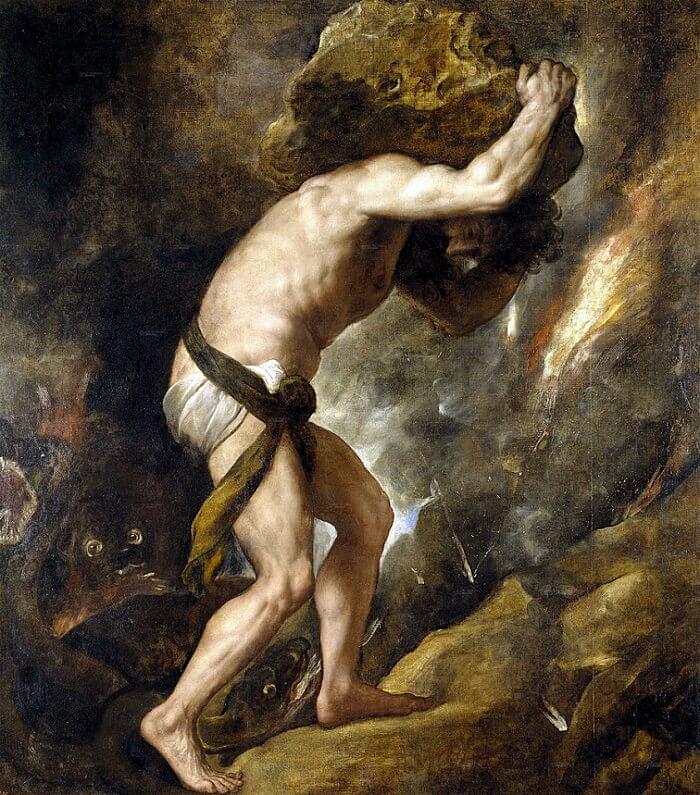
Commissioned by Mary of Hungary for the Binche Palace and painted by Titian c. 1548, Sisyphus documents the story of the King of Corinth, Sisyphus. Sisyphus was condemned to push a boulder to the top of a hill in the Underworld repeatedly, for the rest of eternity as his punishment for many indiscretions during his lifetime [1]. Titian was well-versed in creating mythological narratives and added extraordinary detail to his human figures, which can be seen in this painting [2].
In Sisyphus, Titian shows an interest in the male human form and anatomy, as well as landscape details. Clearly focused on the figure of Sisyphus in the center of the painting, Titian uses lighting to highlight the figure as a whole, but also each individual muscle that is flexed as he struggles with pushing the boulder up the steep hill. Sisyphus wears only a small white cloth around his waist that appears to be slipping, but both hands are firmly above his head to prevent the boulder from falling and likely crushing him. His head is turned towards the viewer, but does not engage with the viewer through eye contact – rather, he is positioned to be looking behind him, with his eyes nearly closed in a defeated manner. The only white light in the painting surrounds Sisyphus, but contrasting religious paintings in which light denotes a holy or pure subject, Titian seems to only indicate that Sisyphus is forced to clear a path through the dark scenery, further reinforcing the strenuous conditions that he lives in. Sisyphus is surrounded by dark smoke that Titian blurs the edges to create a remarkably realistic effect. Titian paints fire and flames directly in front of the figure but uses depth to ensure that it appears in the background. On the bottom left, Sisyphus is followed by hellish creatures that seemingly blend into the smoke, creating the illusion of uncertainty in what lies in the darkness, as well as adding to the overall sense of torture that Sisyphus is facing.
By meticulously capturing these details, Titian allows for the viewer to both understand how grueling his punishment is, and the hell he has been banished to. The story of Sisyphus has also been used to serve as a reminder of what happens when one repeatedly chooses to ignore right from wrong in the eyes of the gods – and Titian's painting reinforces this sentiment by documenting the moral so vividly [3]. Mary of Hungary may have wanted to include this painting in her collection to make clear both to herself and her visitors the ethics she hoped to embody.
[1] Authors of Encylopedia Britannica, "Sisyphus" Encylopedia Britannica
[2] Loh, Maria, “Abracadabra.” In Titian's Touch: Art, Magic, and Philosophy, 56–59.
[3] Authors of Encylopedia Britannica. “The Myth of Sisyphus.” Encyclopædia Britannica
Creator
Titian
Source
Authors of Encylopedia Britannica. “Sisyphus.” Encyclopædia Britannica. Encyclopædia Britannica, inc., 2017. https://www.britannica.com/topic/Sisyphus.
Loh, Maria H. “Abracadabra.” In Titian's Touch: Art, Magic, and Philosophy, 56–59. London, UK: Reaktion Books, 2019.
Authors of Encylopedia Britannica. “The Myth of Sisyphus.” Encyclopædia Britannica. Encyclopædia Britannica, inc., 2019. https://www.britannica.com/topic/The-Myth-of-Sisyphus.
Titian. “Sisyphus, 1548 - 1549 - Titian.” www.wikiart.org, January 1, 1970. Accessed October 20, 2020. https://www.wikiart.org/en/titian/sisyphus-1549.
Publisher
Commissioned by Mary of Hungary
Date
c. 1548
Contributor
Ithika Senthilnathan
Rights
WikiArt, Public Domain
Format
Oil on Canvas, 237cm x 216cm
Type
Oil on canvas painting
Coverage
Museo Nacional Del Prado, Madrid, Spain
Collection
Citation
Titian, “Sisyphus,” ARTHIST 89S - Visual Culture of Venice - Fall 2020, accessed October 22, 2026, https://venice.dahvc.org/fall-2020/items/show/116.