Pietà
Dublin Core
Title
Subject
Description
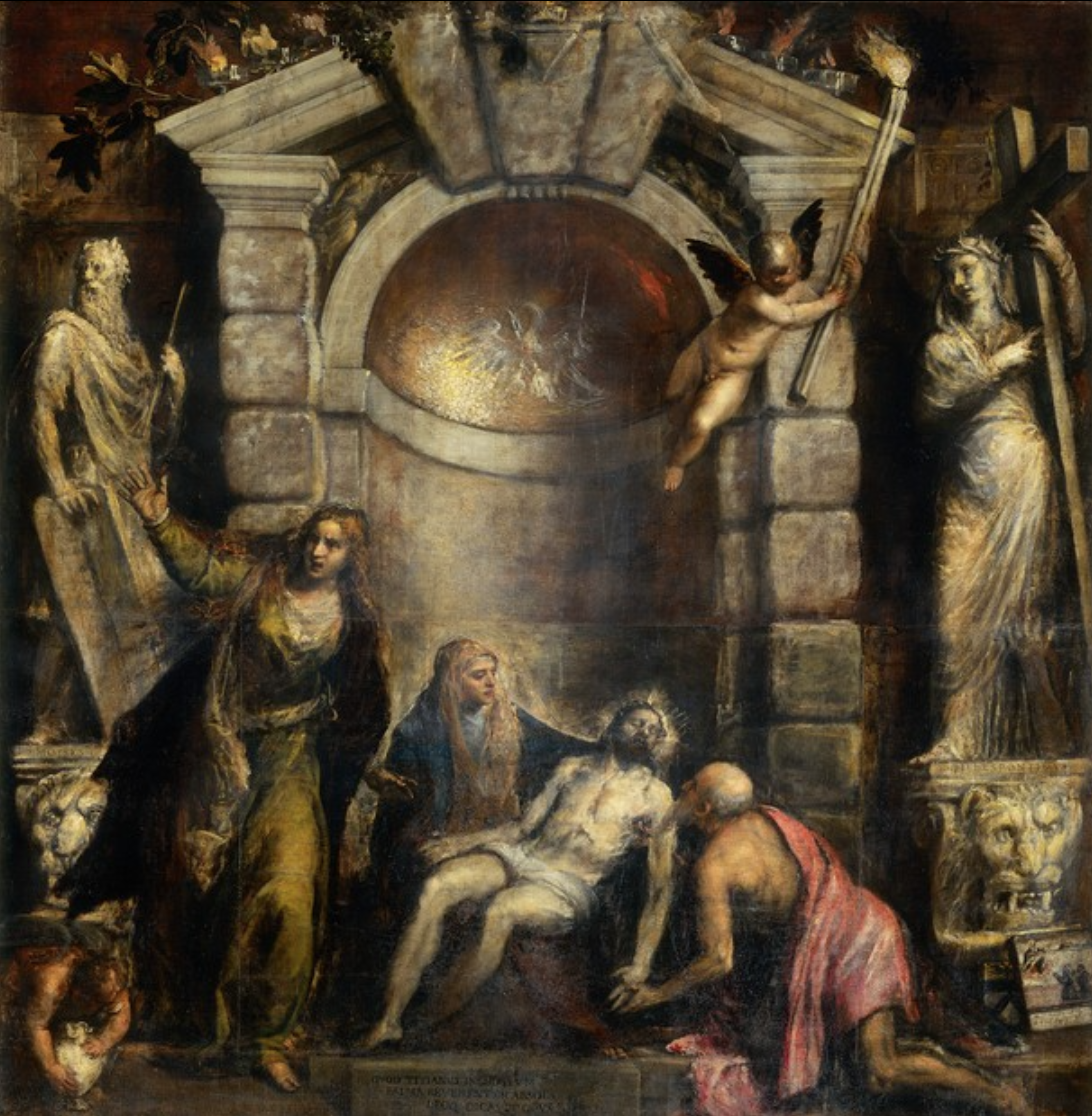
The scene depicted in Titian’s Pietà shows a dead Jesus Christ in the arms of his mother the Virgin Mary. St. Jerome clutches his arm while a startled Mary Magdalene rushes either towards or away from the corpse in horror. Behind the scene is a golden dome-like structure framed by a set of statues representing Moses and Hellespontine Sibyl as well as a vegetation-covered pediment [1]. The dome features an image of a Pelican picking at its own blood to feed its young, a common allegory for the Passion of Christ.
All lines and the flow of action seem to direct the audience's gaze radially inwards towards the limp head of Jesus, the subject of the painting. The muted colors create a sombre mood devoid of life––the result of the vast absence left by the loss of the son of God. The body of Jesus alone is canvassed with a grim, silvery, and unnatural light. We can also see a shift from religious to pastoral imagery as we move up through the work. This symbolizes the natural progression towards death and an inevitable reunification with God.
Pietà was the last work of Titian before his demise by plague in 1576. He modeled the figure of St. Jerome after himself as a prayer to protect himself from the epidemic, the death of Christ symbolic of his own impending one [2]. It was originally meant to be placed on Titian’s grave to earn a spot at the burial site, but following his death it ended up in the church of St. Angelo in Venice prior to being moved to the Gallerie dell'Accademia. The piece was finished by Jacopo Palma Giovane, but why it ended up in his hands is unclear. What is known is that he saw himself as the natural artistic successor to the greatness of Titian, even inscribing on the work his own name [3].
[1] Goffen Rona, Renaissance Rivals: Michelangelo, Leonardo, Raphael, Titian (New Haven: Yale University Press, 2002), 385.
[2] Christopher J Nygren, "Titian's Miracles: Artistry and Efficacy between the San Rocco Christ and the Accademia Pietà," Mitteilungen Des Kunsthistorischen Institutes in Florenz 57, no. 3 (2015): 321.
[3] Józef Grabski, "The Contribution of Collaborators in Titian's Late Works," Artibus Et Historiae 34, no. 67 (2013): 289.Creator
Source
Grabski, Józef. "The Contribution of Collaborators in Titian's Late Works." Artibus Et Historiae 34, no. 67 (2013): 285-310. http://www.jstor.org/stable/23510256.
Nygren, Christopher J. "Titian's Miracles: Artistry and Efficacy between the San Rocco Christ and the Accademia Pietà." Mitteilungen Des Kunsthistorischen Institutes in Florenz 57, no. 3 (2015): 320-49. http://www.jstor.org/stable/43738211.
Rona, Goffen. Renaissance Rivals: Michelangelo, Leonardo, Raphael, Titian. New Haven: Yale University Press, 2002.Image Source: Artstor, accessed September 27, 2020. https://library.artstor.org/asset/SCALA_ARCHIVES_1031314659.