Judith
Dublin Core
Title
Subject
Description
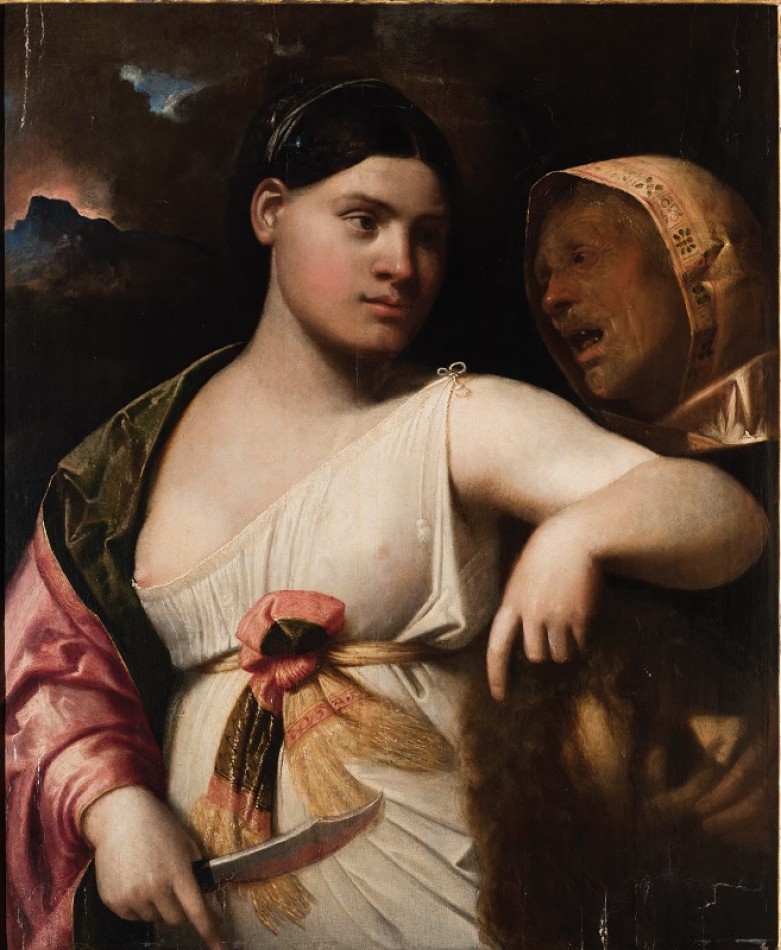
Compared to Giorgione’s Judith, Cariani’s Judith is dark and sensual, beautiful but clearly dangerous. Centrally positioned, Judith emerges from an ominous background filled with storm clouds, her left breast exposed and framed by dark green drapery slung over her shoulder and a pink and gold sash knotted under her bustline (compare to Veronica Franco). She clutches her dagger at her waist, the blade turned up menacingly toward the viewer. Holofernes’s head is marginalized, blending into the black and brown tones of her maidservant’s figure. The maidservant gapes at Judith with missing teeth, her face weathered and almost dehumanized with beady eyes that are half the size of Judith’s. While the violent action toward Holofernes is minimized, the two women pose a threat to the viewer, their faces hardened and partly shrouded as they turn toward each other, colluding in their in their unnatural attack.
Though Judith's brave act saved her community, her action was somewhat contradictory to normative gender behavior in the Italian Renaissance. To mitigate this threat, some men sought to present Judith as dangerous, fearing that contemporary women would be inspired to take public action through her example.
Creator
Source
- Brine, Kevin, Elena Ciletti and Henrike Lahnemann, eds. The Sword of Judith: Judith Studies Across the Disciplines. Cambridge: Open Book Publishers, 2010.
- Foratti, Aldo. "L'arte di Giovanni Cariani." L'Arte 13, no. 3 (1910): 177.
- Pallucchini, Rodolfo. Giovanni Cariani. Bergamo: Credito Bergamasco, 1983.