Browse Exhibits (17 total)
Religious Artwork Throughout the Venetian Renaissance
Venice is one of the most beautiful and unique cities on this planet. Located on the northeastern coast of Italy, this city is built on water giving this city a viewpoint no other city has. Venice exhibits natural spatial, visual, climatic, temporal, experiential, and conceptual properties, hereafter referred to collectively as spatiovisual conditions [1].
Throughout the centuries of the Venetian Renaissance, we have seen many changes throughout the artwork. Specific themes caught my eye, and my favorite Venetian Renaissance theme would be religious themed artwork. Artists began using religious themes in their paintings in the early 14th century, and it became popular in the 15th and 16th centuries. Artists were commissioned by doges, officials, and higher authority to create beautiful religious paintings for their homes or a specific Church. During the Counter-Reformation, the Inquisition was very strict with what artworks met the specific criteria they were looking for. Venetian citizens placed religious-themed paintings in everyday spaces, and they also represented the geographic, economic, and religious climate in Venice throughout the fifteenth and sixteenth century [2].
Throughout this exhibit, we will be viewing some of my favorite religious paintings as well as works of art that represented the common theme. During the Renaissance, artists had to execute their works of art in competition with other artists, dealt with constant spurs of fame and jealousy, and coped with public opinion, or they would be forced to abandon the field [3].
[1] Savoy, Daniel. Venice from the Water Architecture and Myth in an Early Modern City. New Haven, CT: Yale University Press, 2012
[2] Morse, Margaret A. "Creating Sacred Space: The Religious Visual Culture of the Renaissance Venetian "casa"." Renaissance Studies 21, no. 2 (2007): 152.
[3] Ilchman, Frederick, and Linda Borean. “Venetian Painting in the Age of Rivals.” In Titian, Tintoretto, Veronese: Rivals in Renaissance Venice, 21–39. Farnham, MA: Lund Humphries, 2009.
Religious Figures and Scenes in Venetian Renaissance Art and Their Importance
The history of Renaissance art does not begin in the 14th century. It begins during the Classical age. The Renaissance did not create an entirely new form of art, but rather a reconstruction of previous subjects and styles that were altered to fit the Renaissance's culture. It expanded upon and modified the art of the Classical and Medieval ages. The first step in the Renaissance was taken by artists in the 1300s, who were exploring the religious subject matters of the middle age’s paintings in a new light. They took the Medieval two-dimensional art form that focused on the story behind the painting and made the pieces more visually appealing.
Artists began to focus on the beauty of the actual pieces rather than the stories behind them. As art began to move from the low Renaissance to the High Renaissance and Early Modern periods, subjects that were last prevalent in works of art about a thousand years earlier began to reappear. Scenes of Roman and Greek deities and stories began to be commissioned and were used in a symbolic manner with illusion to Christian Beliefs.
In Venice, artists like Jacopo, Gentile, and Giovanni Bellini, Vittore Carpaccio, Giorgone, Tiziano Vecelli, Paolo Veronese, and Jacopo Robust (Tintoretto) propelled the artistic culture forward during the Early Modern Era by developing their own styles and methods over their lifetime. However, the artists were not in charge of every scene that they put onto canvas. Most of their works were commissioned by Venetian patrons or members of the Church who told the artist what to paint. So these artists were not necessarily painting what they wanted to paint.
From my perspective, the Catholic Church used their commissions to depict scenes with religious subjects like miracles, saints, and figures in the church for its own betterment and to achieve its own personal goals. The money that was put into these projects was progressing the artistic culture in Venice, while also displaying the power of the Church through wealth.
Religious Paintings and the Stories they Convey
Throughout the Early Modern period in Venice, religion played a significant role in society. Christianity dominated everyday life for citizens, with the Roman Catholic Church present in many various aspects of Venetian culture. The importance of religion was reflected in the art of fifteenth and sixteenth century Venice. It was a common theme across many paintings, with artists interpreting classic biblical stories and utilizing Christian symbols in their own ways. As Peter Humfrey states, Venetian artists in the Early Modern era incorperated a blend of narrative and iconic elements in their works, emphasizing the key moral truths of the Bible [1]. Patrons, such as individuals, government entities, and religious institutions, supported and employed painters in Venice in order to obtain works of art that conveyed the religious messages they desired.
Artists were often commissioned to depict biblical stories, narrating to the viewer concepts and themes from the Bible. Many painters were commissioned to create allegorical art that displayed Christian morality, diving into what it means to be a good Christian Venetian citizen. In addition, patrons, especially religious and government figures in Venice, wanted portraits that displayed their strength and influence [2]. They commissioned artists to create art showcasing their power, reflecting on their divine sanction through the use of Christian symbolism. The works of art that I have chosen for this exhibit explicate the relationship between narratives and religious paintings, underscoring the role art had on reflecting the culture of Venice.
Overall, this exhibit analyzes the various messages and stories religious art illustrated during the Early Modern period in Venice. I chose to dive into the theme of religion because it plays such a meaningful role in Venetian art, providing a contextual frame for understanding other works of art from the time. This exhibit serves as a collection of paintings that are integral to understanding the significance of religious work and the stories they convey. The goal is to highlight the function of these paintings as methods of storytelling, ultimately revealing the Venetian culture and its mythical nature.
[1] Peter Humfrey, “Introduction,” in The Altarpiece in Renaissance Venice (New Haven: Yale University Press, 1993): 13.
[2] Rona Goffen, “Crossing the Alps: Portraiture in Renaissance Venice,” in Renaissance Venice and the North: Crosscurrents in the Time of Bellini, Dürer, and Titian (New York: Rizzoli, 2000): 115.
Renaissance Influence on Religious Artwork in Early Modern Venice
The advent of the Renaissance inspired many changes in religious art in early modern Venice, both as a result of the changes in religious doctrine as a result of the Reformation and Counter-Reformation and of the promotion of the ideas associated with humanism. The religious scenes depicted in this exhibition differ vastly from each other and from works created in the medieval era of Venice. The Renaissance and its effects dramatically changed the landscape of religious artwork, making it more realistic, more open to personal interpretation from the the viewer, and more variable from artist to artist. These changes heavily influenced and later reflected the changes incorporated by the Catholic Church as a result of the Counter Reformation and the Council of Trent.
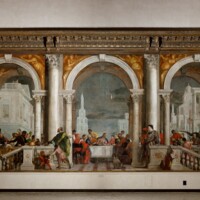
Peter Humphrey's "Altarpieces and altar dedications in Counter-Reformation Venice and the Veneto" explored how altarpieces and their dedications changed as a result of the Counter-Reformation. Through looking at trends in altarpieces both before and after the Counter-Reformation, Humphrey has shown how the Counter-Reformation did induce a shift in the subjects and depictions of altarpieces, specifically in a shift from the sacra conversazione to narrative paintings, which provided the audience a stronger connection to the subjects in the painting and their stories. This idea of creating stronger connections with viewers was promoted in Venice long before the Counter-Reformation, however. Renaissance artists had already started accomodating that shift to a more personal interpretation both in terms of how the artist depicted the painting and how the audience was supposed to view the painting. In fact, the Catholic Church higher scrutiny of religious artwork after the Counter-Reformation often complicated this notion of individualized artistic styles as artists could be censored and interrogated for their interpretations of key religious scenes, as in the case of Paolo Veronese in Feast in the House of Levi.
This exhibition has two aims. First, it celebrates the religious artwork of artists during the Renaissance in early modern Venice and their significance in shaping and promoting the religious ideals of the Catholic church and the Renaissance. Second, through the affordance of the digital medium, it draws attention to the diversity of artists and their styles and techniques and their individual evolution as humanism and the religious tension as a result of the Reformation and the Counter-Reformation influenced their art. Through three digital galleries, individual works appear several times as illustrations of overlapping themes, allowing for visualizations of the intersections of these humanistic ideals. This exhibition argues that rather than responding to top-down changes in guidelines of how religious art should be depicted, these early modern Venetian artists tapped into the cultural shift occurring to model the shifts in religious doctrine in their Christian art.
The Meaning of Myths: The Use of Mythology in Paintings of Renaissance Venice
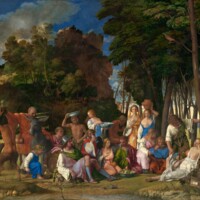
As Venetian paintings began to transform in style and medium in the sixteenth century, their subjects also began to change. Throughout the fifteenth century, most paintings had religious subjects and Bellini was known as the great painter in Venice. When Titian emerged on the scene in the sixteenth century, the shift towards the use of mythological scenes and gods and goddesses as the subjects of paintings began.
The female figure was depicted in many works of Renaissance Venice. It is used in several paintings with mythological subjects, usually depicting goddesses. These works usually included few figures and did not show a specific scene or story, rather drawing the attention solely to the woman in the painting.
Paintings with mythological subjects also often taught a moral lesson, much like the myths themselves. Greek mythology often taught these morals through the tragedies of people caused by their own choices, and the paintings depict similar values.
Finally, many paintings showed dramatic representations of scenes from myths. In these works, a specific, recognizable scene from a myth is depicted, usually in a style with lots of color and movement of the figures.
Mythology was used as a subject in Venetian paintings in several different ways and styles. Titian especially was very famous for his mythological paintings, and was often comissioned especially for them.
Venetian Interpretation of Mythological Allegories
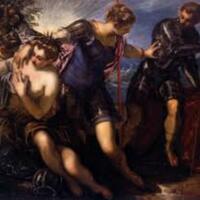
With a strong relationship between Venetians and traditional Roman mythology, most notably the stories of the Olympian gods, it comes as no surprise that many Venetian artists were commissioned to tell these famous stories. In a city as unique and prideful as Venice however, the artists did not simply tell the stories in the exact way that Romans may have intended – rather, they created masterpieces that promoted their own ideals simultaneously. In this exhibit, we will explore the Venetian interpretation of mythological allegories, from who the key influences on storytelling through painting were, how Venetian ideals of government and society were illustrated in specific aspects of paintings including details in the figures and backgrounds, and finally, how these ideals perpetuated an idealized female form.
The promotion of Venetian ideals is present in several pieces of artwork created by both Venetian and other European artists, as well as the concept of the “myth of Venice” – the idea that Venice existed in unique excellence from every other city, in terms of art, socioeconomic structure, and physical origins [1]. Artists were frequently commissioned to highlight Venice in a favorable light by accentuating a strong society that emphasized justice, wisdom, ideal marriage, and empowered female roles. While artists reflected these ideals in various forms of artwork that all took on different subject matters, the integration of Venetian traits into traditional Greco-Roman myths allowed artists to blend two unique worlds into one, resulting in incredible pieces of art that showcased the city’s prestige. I chose to analyze the relationship between these two methods of storytelling because it signifies an essential part of Venetian life and the role of art. This exhibit will delve into my favorite pieces of artwork that fall into the three aforementioned categories, with a large variety in subject matter and artistic techniques.
[1] David Rosand, Myths of Venice: The Figurations of a State (Chapel Hill: University of North Carolina Press, 2001), 6.
Women of Venice: Makers, Movers & Shakers