Renaissance Influence on Religious Artwork in Early Modern Venice
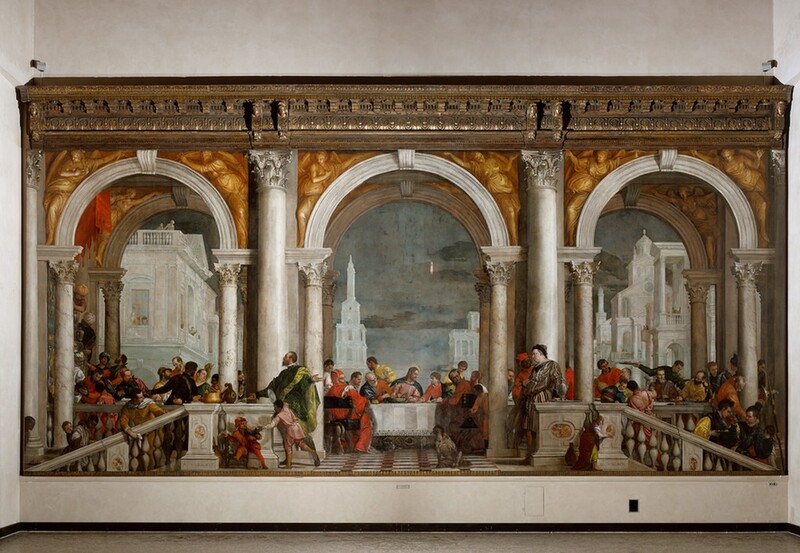
The advent of the Renaissance inspired many changes in religious art in early modern Venice, both because of the changes in religious doctrine as a result of the Reformation and Counter-Reformation and of the promotion of the ideas associated with humanism. The religious scenes depicted in this exhibition differ vastly from each other and from works created in the medieval era of Venice, becoming more realistic, more open to personal interpretation from the the viewer, and more variable from artist to artist. These changes heavily influenced and later reflected and subverted the changes incorporated by the Catholic Church as a result of the Counter Reformation and the Council of Trent, especially in Venice, a city whose wealth, independence, and cosmopolitan idenity made it particularly open to varying artistic interpretations and innovations.
Peter Humphrey's "Altarpieces and Altar Dedications in Counter-Reformation Venice and the Veneto" explored how altarpieces and their dedications changed as a result of the Counter-Reformation. Through looking at trends in altarpieces both before and after the Counter-Reformation, Humphrey has shown how the Counter-Reformation did induce a shift in the subjects and depictions of altarpieces, specifically in a shift from the sacra conversazione to narrative paintings, which provided the audience a stronger connection to the subjects in the painting and their stories [1]. This idea of creating stronger connections with viewers was promoted in Venice long before the Counter-Reformation, however. Renaissance artists had already started accomodating that shift to a more personal interpretation both in terms of how the artist depicted the painting and how the audience was supposed to view the painting. In fact, the Catholic Church higher scrutiny of religious artwork after the Counter-Reformation often complicated this notion of individualized artistic styles as artists could be censored and interrogated for their interpretations of key religious scenes, as in the case of Paolo Veronese in Feast in the House of Levi [2]. However, because of Venice's unique social structure that incorporated civic participation, religion in terms of the Catholic Church's restrictions had less of an effect on an artist's ability to express themselves freely, often being censored or interrogated after the painting's creation [3]. This exhibit builds on the work of these scholars by providing a comprehensive view of how Venetian art evolved as a result of not only the Counter Reformation but also the humanistic ideas of the Renaissance.
This exhibition has two aims. First, it celebrates the religious artwork of artists during the Renaissance in early modern Venice and their significance in shaping, promoting, and complicating the religious ideals of the Catholic church and the Renaissance. Second, through the affordance of the digital medium, it draws attention to the diversity of artists and their styles and techniques and their individual evolution as humanism and the religious tension as a result of the Reformation and the Counter-Reformation influenced their art. Through three digital galleries, individual works appear several times as illustrations of overlapping themes, allowing for visualizations of the intersections of these humanistic ideals. This exhibition argues that rather than responding to top-down changes in guidelines of how religious art should be depicted, these early modern Venetian artists tapped into the cultural shift occurring in everyday people around the world to model the shifts in religious doctrine in their Christian art.
[1] Humfrey, Peter. "Altarpieces and Altar Dedications in Counter-Reformation Venice and the Veneto." Renaissance Studies 10, no. 3 (1996): 371-87. Accessed November 17, 2020. http://www.jstor.org/stable/24412331.
[2] Grasman, Edward. "On Closer Inspection - The Interrogation of Paolo Veronese." Artibus Et Historiae 30, no. 59 (2009): 125-34. Accessed November 17, 2020. http://www.jstor.org/stable/40343668.
[3] Rich and Poor In Renaissance Venice: the Social Institutions of a Catholic State, to 1620. Oxford: Blackwell, 1971. https://hdl.handle.net/2027/heb.00039. EPUB.