Browse Items (12 total)
- Collection: Dana's Collection
Sort by:
Self-portrait of Marietta Robusti
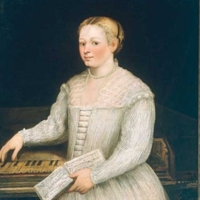
In this portrait – believed to be a self-portrait of Marietta Robusti – the sitter gazes outward at the audience with a slight smile. Turned in a three-quarter pose toward the spinet, her left hand floats above the keys as if surprised by the viewer…
Portrait of Tullia d'Aragona as Salome
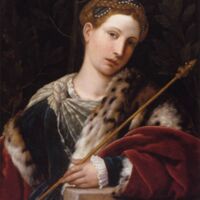
A centrally-positioned woman gazes directly at the viewer, her head cocked to the side as she reclines on a stone wall bearing an inscription. This inscription identifies one level of the figure’s identity as the biblical femme fatale Salome: "QVAE…
Portrait of Caterina Cornaro as Saint Catherine of Alexandria
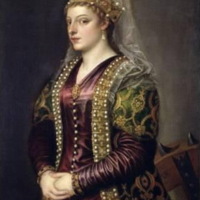
Standing tall and regal in a three-quarter pose, Caterina gazes sideways at the viewer with composure, her lips pursed and hands clasped together in front of her. Her lavishly-robed figure fills the frame, positioned against a sober black background…
Portrait of a Lady (Veronica Gambara)
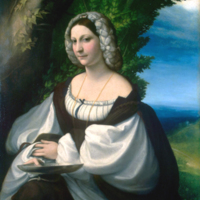
In a pastoral setting of a symbolic laurel and a changeable blue sky, the poet is placed in the imaginary domain of her works. With a half-smile, she turns toward the viewer from her three-quarter pose, apparently seated on the grass or perhaps a log…
Portrait of a Lady (Veronica Franco?)
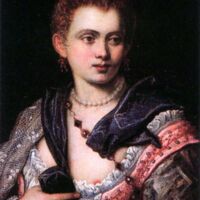
Unlike the supposed portrait of fellow poet-courtesan Tullia d’Aragona, Franco’s eyes are averted from the viewer, so she poses no direct challenge to her audience. Her face recedes into shadow, partially hidden from the viewer, leaving her…
Plaque with the Personification of Africa (?)
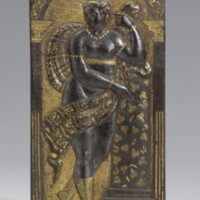
The ebony, semi-nude body of a woman emerges from a gold ground, positioned in a decorative niche as an allegorical figure. She is in motion, with one foot lifted as she stands in contrapposto, one arm raised to grasp a loop of billowing drapery near…
Moderata Fonte
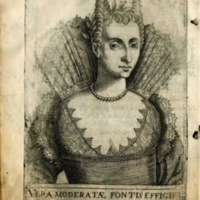
“I await fame and glory in life, and then in death” [1].
Like Tullia d’Aragona’s dialogue, Moderata Fonte’s Il merito delle donne (1600) is a commentary on the dialogues of philosophers and humanists, which were almost exclusively composed of male…
Judith
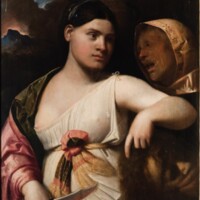
Compared to Giorgione’s Judith, Cariani’s Judith is dark and sensual, beautiful but clearly dangerous. Centrally positioned, Judith emerges from an ominous background filled with storm clouds, her left breast exposed and framed by dark green drapery…
Judith

Giorgione’s Judith is a beautiful young widow who has already slain the Assyrian general Holofernes. In fifteenth and sixteenth-century Italy, Judith often served as an allegorical figure of Virtue triumphant, or as the victor in a number of binary…
Galleon at Sea
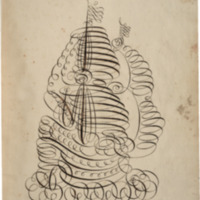
This calligraphic drawing was created as part of Giovanna Garzoni's "Libro de’ caratteri cancellereschi corsivi," or “Book of Chancery Cursive Letterforms.” Garzoni, an itinerant artist, was born in Ascoli Piceno to a Venetian family and is believed…