Browse Items (177 total)
Sort by:
Bacchus and Ariadne
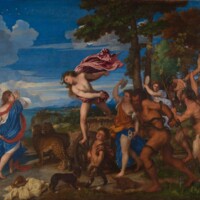
Depicted here we see the Roman god of wine and fertility, Bacchus, jump from his chariot to meet with the Cretan princess, Ariadne, with whom he has fallen in love. Titian highlights these two figures, using a lighter shade for their skin compared…
Bacchus and Ariadne
In this painting, we see Bacchus, the god of wine, leaping from his chariot towards Ariadne, who has been abandoned by her lover, to protect her from his revelers close behind. Titian highlights the central tension between Bacchus and Ariadne in…
Portrait of Bishop Bernardo de’ Rossi
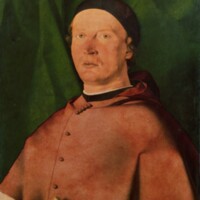
Lorenzo Lotto was commissioned to create a portrait for the Bishop Bernardo de’ Rossi that showed his elegance and status. Lorenzo Lotto, born in Venice in 1480, learned how to paint with the Murano school, as Henry S. Francis points out, working on…
A Sparrowhawk
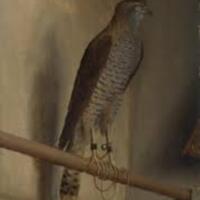
Jacopo de’ Barbari was a Venetian painter, famous for having his own unique style. De’Barbari was a printmaker and even engraved wood to portray some of his pieces, which have been known to be highly influential [1]. He is probably most remembered…
Doge Leonardo Loredan
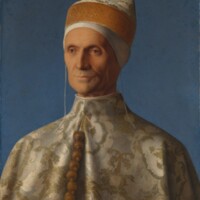
The portrait of Doge Leonardo Loredan is one of Giovanni Bellini's most famous paintings, and it is currently in the National Gallery in London, United Kingdom. Doge Leonardo Loredan ruled Venice from 1501 to 1521, and Bellini completed the painting…
The Adoration of the Kings
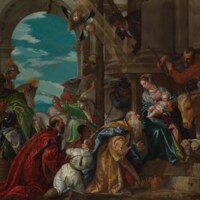
Paolo Veronese, or Paolo Caliari, painted the Adoration of the Kings, a piece that is also known as The Adoration of the Magi, in the early 1570s for the Scuola de San Giuseppe for the Church of San Silvestro [1]. In this piece, Veronese’s distinct…
Portrait of a Young Man (or Portrait of a Gentleman in His Study)
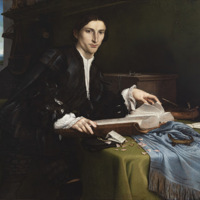
Although the name and identity information of the young man in the portrait is not recorded, the objects placed around the characters provide clues to the audience to trace and decipher his secrets. Just like the painter's consistent style, Lotto…
Feast in the House of Levi
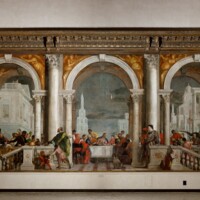
The large white archways and Corinthian style marble pillars immediately give Veronese's painting a classical architectual syle and a sense of grandeur. The archways are large and ornate and give views into the large banquet taking place. The space…
Judith
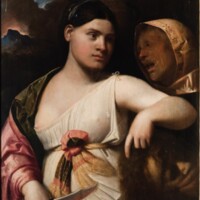
Compared to Giorgione’s Judith, Cariani’s Judith is dark and sensual, beautiful but clearly dangerous. Centrally positioned, Judith emerges from an ominous background filled with storm clouds, her left breast exposed and framed by dark green drapery…
Self-portrait of Marietta Robusti
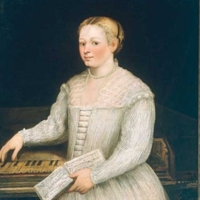
In this portrait – believed to be a self-portrait of Marietta Robusti – the sitter gazes outward at the audience with a slight smile. Turned in a three-quarter pose toward the spinet, her left hand floats above the keys as if surprised by the viewer…