Browse Items (177 total)
Sort by:
Portrait of Tullia d'Aragona as Salome
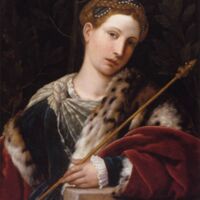
A centrally-positioned woman gazes directly at the viewer, her head cocked to the side as she reclines on a stone wall bearing an inscription. This inscription identifies one level of the figure’s identity as the biblical femme fatale Salome: "QVAE…
Portrait of Doge Mocenigo
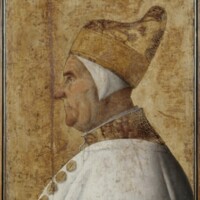
This portrait was a later work of Gentile Bellini that showcases his flat patterned style that has been used to identify other works of his. The painting takes on a side-portrait view of the doge depicting him in a very stately and pious manner. He…
Portrait of Caterina Cornaro as Saint Catherine of Alexandria
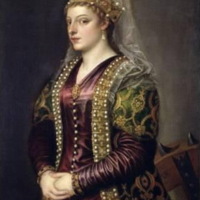
Standing tall and regal in a three-quarter pose, Caterina gazes sideways at the viewer with composure, her lips pursed and hands clasped together in front of her. Her lavishly-robed figure fills the frame, positioned against a sober black background…
Portrait of a Lady (Veronica Gambara)
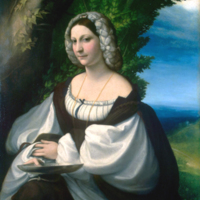
In a pastoral setting of a symbolic laurel and a changeable blue sky, the poet is placed in the imaginary domain of her works. With a half-smile, she turns toward the viewer from her three-quarter pose, apparently seated on the grass or perhaps a log…
Portrait of a Lady (Veronica Franco?)
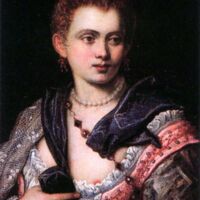
Unlike the supposed portrait of fellow poet-courtesan Tullia d’Aragona, Franco’s eyes are averted from the viewer, so she poses no direct challenge to her audience. Her face recedes into shadow, partially hidden from the viewer, leaving her…
Pope Paul III with his Grandsons
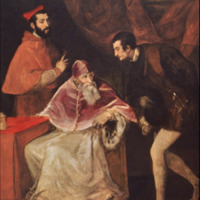
This unfinished work by Titian––Pope Paul III with his Grandsons––is a testament to the legacy of the commissioning Farnese family of Italy [1]. In this work, a frail and decrepit old man sits on a chair flanked by two younger members of his family.…
Plaque with the Personification of Africa (?)
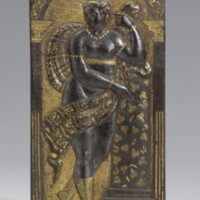
The ebony, semi-nude body of a woman emerges from a gold ground, positioned in a decorative niche as an allegorical figure. She is in motion, with one foot lifted as she stands in contrapposto, one arm raised to grasp a loop of billowing drapery near…
Pietro Aretino
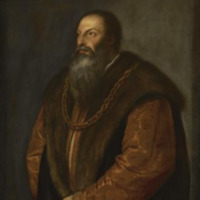
Pietro Aretino was an influential Italian author during the sixteenth century. In addition to his artistic work, however, he was a friend to countless people in power and was nicknamed “the scourge of princes” for his use of blackmail against…
Pietà
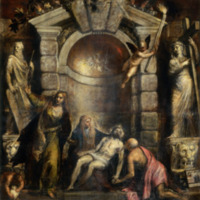
The scene depicted in Titian’s Pietà shows a dead Jesus Christ in the arms of his mother the Virgin Mary. St. Jerome clutches his arm while a startled Mary Magdalene rushes either towards or away from the corpse in horror. Behind the scene is a…
Paradise
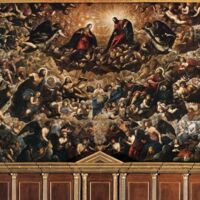
The painting Paradise, made by Jacopo and Dominico Tintoretto from 1588-1592, is featured in the Ducal Palace and represents the greatness of Venice during this time period. It is featured across the expanse of the Great Council wall and stands above…