Browse Items (177 total)
Sort by:
St. Jerome and the Lion
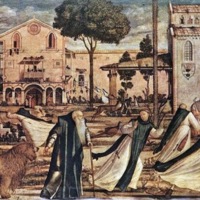
The context of this image is that Vittore Carpaccio reveals Saint Jerome next to a lion while others around him are scared and running away from him. The image is the second of seven total paintings that depict Saint Jerome and is part of the…
The Dream of St. Ursula
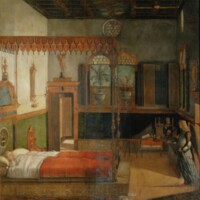
The Dream of Ursula was created by Vittore Carpaccio in 1495 and is currently placed in the Gallerie dell'Accademia in Venice, Italy. This painting is the fifth canvas out of the nine large paintings in the series "Stories from the Life of St…
Legend of St. Ursula: Dream of St. Ursula
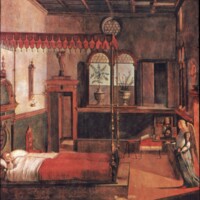
This oil painting is the fifth in Vittore Carpaccio’s "Stories from the Life of St Ursula," commissioned by a scuola piccola called the Sculoa di San’Orsola to be displayed in their meeting house where prayer and devotion often occurred. A relatively…
Saint Christopher
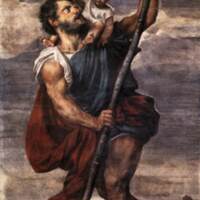
This piece was one of the few artworks to survive from the fires in the Ducal palace [1]. While in its current form the edges are slightly withered, the fresco remains largely intact. The image was originally commissioned by the Holy Church, and is…
Pietà
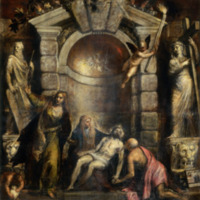
The scene depicted in Titian’s Pietà shows a dead Jesus Christ in the arms of his mother the Virgin Mary. St. Jerome clutches his arm while a startled Mary Magdalene rushes either towards or away from the corpse in horror. Behind the scene is a…
Portrait of Caterina Cornaro as Saint Catherine of Alexandria
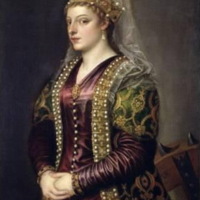
Standing tall and regal in a three-quarter pose, Caterina gazes sideways at the viewer with composure, her lips pursed and hands clasped together in front of her. Her lavishly-robed figure fills the frame, positioned against a sober black background…
The Virgin and Child between Saints Anthony of Padua and Roch
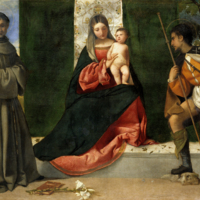
For a period the work was attributed to Giorgone, but in 1904 it was then changed and attributed to Titian by scholar Wilhelm Schmidt [1]. While some scholars still disagree, most conclude Titian was the original author but took inspiration from…