Browse Items (177 total)
Sort by:
The Bacchanal of The Andrians
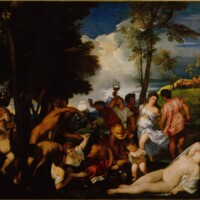
Here we see a group of followers of Bacchus enjoying themselves, drinking from the wine of the new river--a gift from Bacchus. Much like other pieces of his, Titian creates a sense of depth through the landscape; the trees and the green of the…
Sisyphus
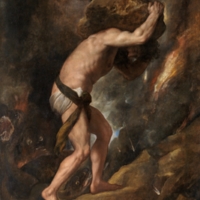
Titian, one of the most important members of the 16th century Venetian school, was an Italian painter during the Renaissance [1]. Titian was famous for his drastic use of color, where he used calculated brushwork and subtle tone to spread his…
Bacchanal of the Andrians
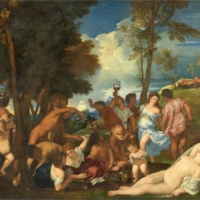
The painting Bacchanal of the Andrians by Titian was made from 1523 to 1526 and is located in the Prado Museum in Madrid, Spain. This painting was one of the pieces of art Titian made for the Duke of Ferrara, Alfonso d’Este. This portrait has many…
Bacchus and Ariadne
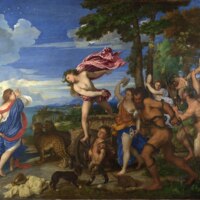
The painting Bacchus and Ariadne, created by Titian between 1520 and 1523, is a depiction of the Myth of Ariadne. Specifically, it depicts the version in the 64th poem of Catullus [2]. In the myth Ariadne, daugther of the King of Crete, helps the…
Diana and Actaeon
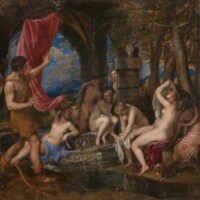
The painting of Diana and Acteon is considered to be one of Titian's greatest works that he’s produced. After initially viewing the painting, Actaeon dropped his bow in shock with arrows strapped on his back. I infer that this led to the Death of…
Bacchus and Ariadne
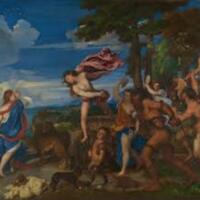
Bacchus and Ariadne, painted by Titian ca. 1520-1523, depicts the story of Bacchus, the god of wine, encountering Ariadne, the daughter of King Minos, for the first time. In the painting, we see Bacchus jumping from his chariot in such a haste that…
Bacchus and Ariadne
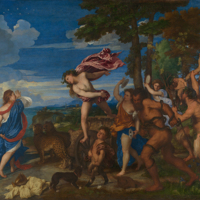
Titian is commissioned by the Duke of Ferrera, Alfonso d’Este, to create a painting for a room within the castle at Ferrara. In the early 1520’s he creates this colorful piece Bacchus and Ariadne depicting the story of its namesaske, Bacchus and…
Bacchus and Ariadne
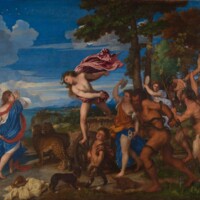
Depicted here we see the Roman god of wine and fertility, Bacchus, jump from his chariot to meet with the Cretan princess, Ariadne, with whom he has fallen in love. Titian highlights these two figures, using a lighter shade for their skin compared…
Bacchus and Ariadne
In this painting, we see Bacchus, the god of wine, leaping from his chariot towards Ariadne, who has been abandoned by her lover, to protect her from his revelers close behind. Titian highlights the central tension between Bacchus and Ariadne in…
Saint John the Evangelist on Patmos
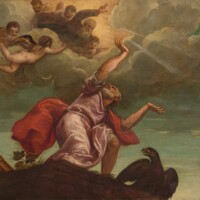
This painting was commissioned to Titian in 1544 for the new albergo (board room). This one of the wealthiest religious confraternities in Venice, stated in the National Gallery of Art article. This painting was one of four original scuole grandi.…