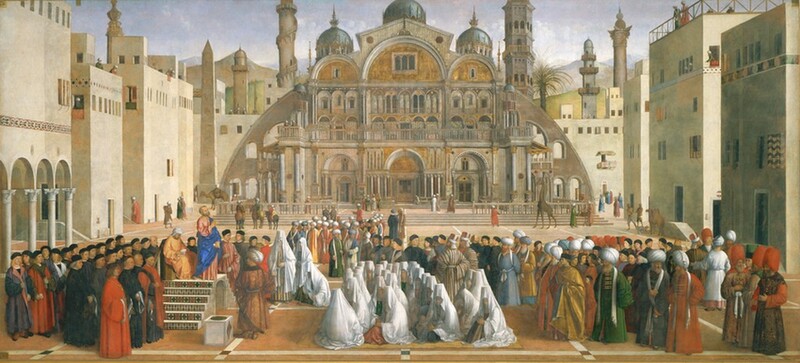
Architectural

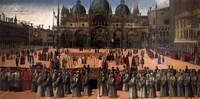

The architectural background type was also reimagined by Venice's Renaissance artists and applied in a manner that speaks to the region's artistic prowess. Specifically, in Venice, the island's buildings became an integral part of the city’s past, present, and future. Certain structures, including the lay confraternities, various churches, and royal spaces, became the forefront or facade of Venetian culture. In Bellini’s Procession in St. Mark’s Square, the procession of the true cross is staged at none other than the Piazza San Marco. The plaza, which is surrounded by the Doge’s Palace, Saint Mark's Basilica, and Procurate Vecchie, is known in Venice as a place of great importance and a cultural center for the region's activities. The buildings standing tall create a box-like perimeter with ornate facades and arched windows. Not only do the buildings' directional pointing focus the viewer’s attention on the foreground spectacle, but they also demonstrate a sense of protection from the outside. In an enclosed space, the exclusivity and focus on the event are enhanced. In modern times one could compare the framing to that of a sports arena, where the design of the surrounding structure is created to enhance the viewer’s experience and include the audience in the activity at hand.
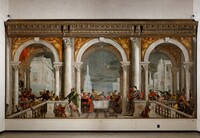
Veronese’s Feast in the House of Levi uses the architectural background type to reference Venetian ideals. The background is filled with churches and towers, a direct representation of the city of Venice. These buildings provide depth for the scene, similar to natural backgrounds, but also reaffirm the fact that the work is a Venetian commission by a Venetian artist. Venice's citizens were incredibly proud of their city’s accomplishments, intelligence, and commercial success, so boasting their identity was a must in many works. It is important to note the impressiveness of architectural constructions themselves. Often created with highly detailed ornamentations or multi-story structures, these engineering and design feats were no easy task. Architects like Andrea Palladio developed reputations for their craft and defined the Venetian building style as a unique and innovative approach.
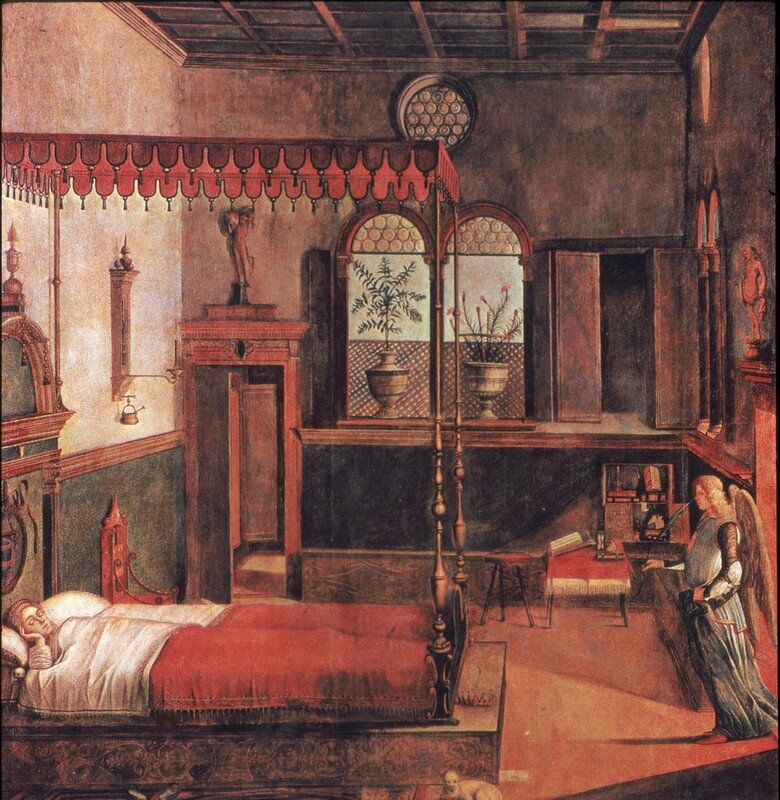
Architectural backgrounds can also be much smaller in scale, as seen in works such as the Vision of St. Augustine. In Carpaccio’s work, St. Augustine is seen with a pen in hand at a desk within a fairly compact study room. The surrounding walls enclose the space with a decorated ceiling and painted walls. The room's rectangular prism shape translates the two-dimensional image into a three-dimensional perspective for the viewer. Instead of the image being an illustration of St. Augustine, it instead captures a moment in time. It feels as if the viewer is a part of the space and could move around the room, experiencing the event first hand from different angles. In a condensed explanation, the image's realism is largely improved, and a higher degree of relatability is created. This phenomenon is apparent in the Venus of Urbino. The bedroom quarters' enclosed space convinces the viewer they could be the one Venus’s gaze is directed to as if they had stepped into the room themselves.