Natural
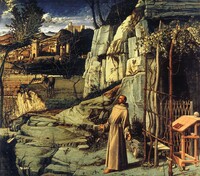
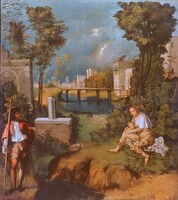
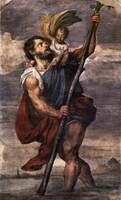

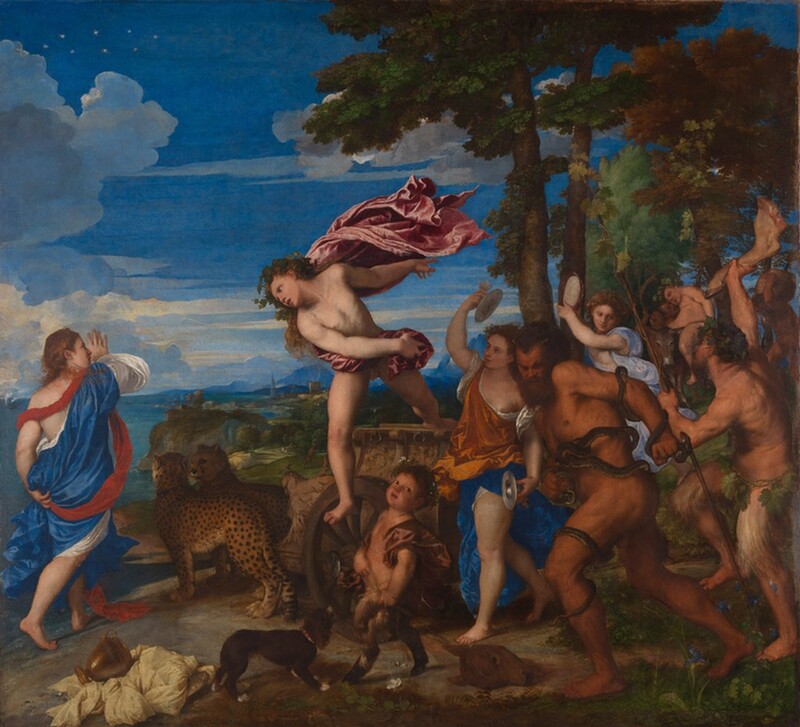
The natural landscape is an integral part of many great works from artists such as Bellini, Titian, and Giorgione. While natural landscape backgrounds aren't distinctly Venetian and have their first origins in 4th century China, the element was embraced by Renaissance artists to enhance their illustrations [1]. It is important to define the “natural landscape,” which is considered most broadly the depiction of natural scenery in art [1]. Such natural elements include mountains, valleys, bodies of water, fields, forests, and coasts [1].
The emergence of the Renaissance period in Venice led to a newfound use of landscape backgrounds, as evident in The Tempest. In the middle of Giorgione’s painting, a small river flows from the front of the image towards the back, which establishes depth and a perspective of space within the scene. In a two-dimensional image, it is difficult to represent space without eye catching objects that serve as reference points. A significant influence on the success of natural landscape backgrounds is the relatability between the viewer and the image the pigment creates. Most everyone has seen a river, clouds high up in the sky, or a collection of shrubs in their yard. These seemingly familiar objects serve as a gateway to added realism and a more accurate sense of scale. Also evident in The Tempest is the expressive power of natural landscape backgrounds. The sky above is painted in a dark grey color with varying shades. In between the clouds, a bright lightning bolt is captured at a split second in time, creating a glow in the envelope of darkness. At this point, the natural elements establish feelings and set up the context of the scene. In this case, one can take away a sense of chaos, disorder, or frustration. Metaphorically the “state” of the natural landscape can be connected with the divine and a link of communication between the mortal world and the heavens.
In some works, the implications of the natural landscape background are more deliberate than others. In Bellini’s St. Francis in the Desert, the natural background is practically the main focus of the work. It carries the symbolic meaning of St. Francis’ awe with God’s creation, an ode to the divinity of nature and natural elements.
Titian’s use of the natural landscape background provides the physical context of the scene, another effective use of the type. In Saint Christopher, the back right of the image is a series of mountains, formed similar to those located off of the coast of Venice proper in Italy. Not only do they convey the location of the scene, but it is additionally used to provide scale. Saint Christopher, clearly drawn out of proportion, towers over the mountains and stands head level with the clouds in the sky. In this instance, the natural landscape effectively removes the realism; however, it is entirely intended by the painter.
[1] “Landscape Painting,” Encyclopædia Britannica, Encyclopædia Britannica, inc, accessed November 19, 2020, https://www.britannica.com/art/landscape-painting.