Tityus
Dublin Core
Title
Subject
Description
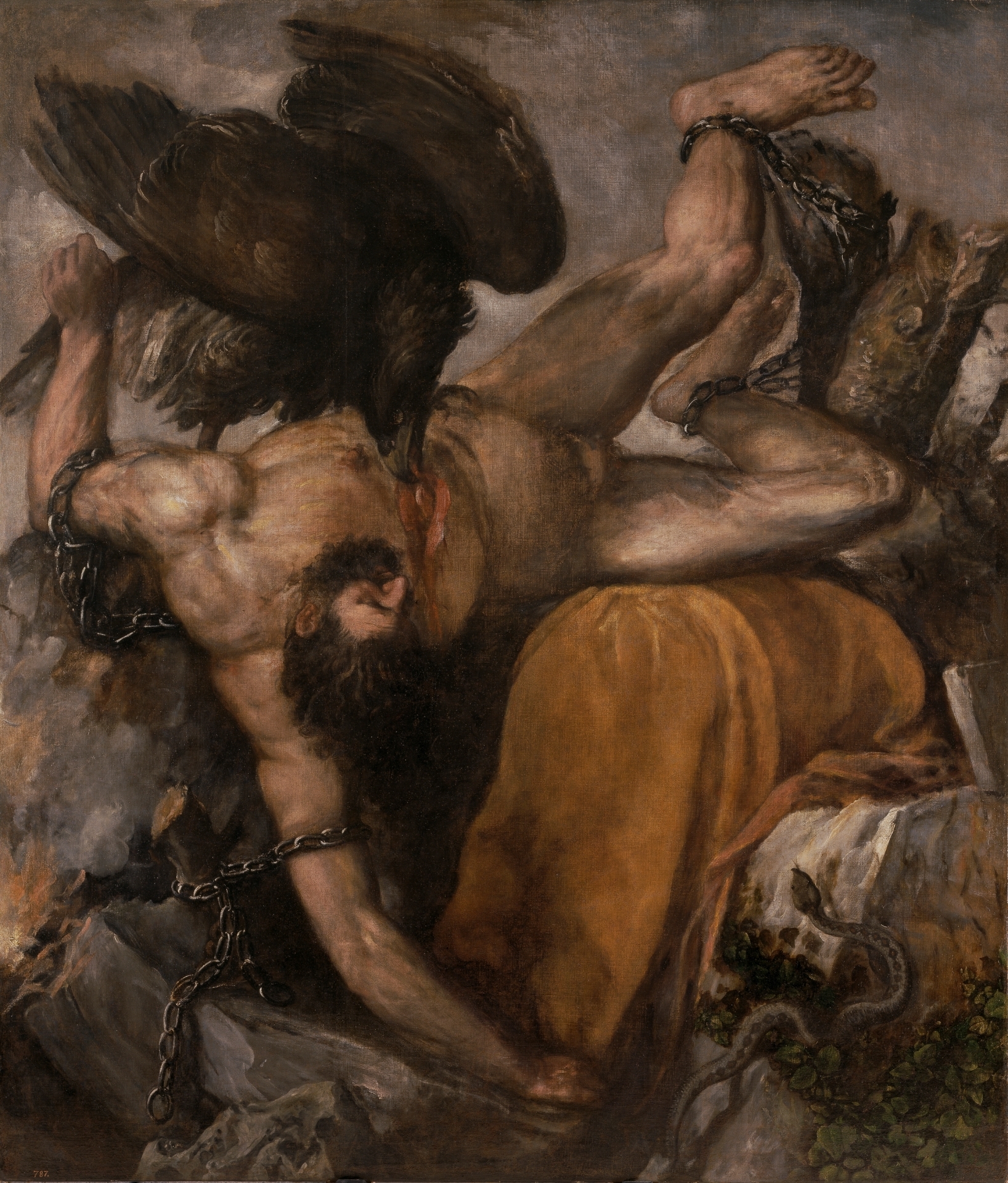
Tityus, sometimes spelled Tityos, is a giant from ancient Greek mythology and the illegitimate son of Zeus and Elara. After attempting to rape Leto, he is killed by the gods Artemis and Apollo and sent to eternal damnation in the depths of the Greek underworld Tartarus. Here, his punishment is to be strapped to a rock, where his liver serves as food for two ravenous vultures. At the end of each day, it regrows to start the process over again [1].
In Titian’s Tityus, the giant dominates the frame. The artist notably shows off his ability to construct a contorted figure while still displaying excruciating pain in its features. Surrounding Tityus are a combination of symbols from both the ancient Greek underworld and the Christian hell, such as the serpent to his right––a prototypical representation of Satan––as well as the fiery river Phlegethon that runs behind him. Most of the painting employs muted grayscale tones, granting a degree of solemnity and seriousness to the subject. This dullness, however, is interrupted by the striking red gash that the birds have carved into Tityus’ side. The color directs the viewer’s gaze to this focal point in lieu of light, which often serves the same purpose but is played down to further the suffering that the giant experiences.
This work by Titian was part of a four-painting cycle called the “Furias,” commissioned by Mary of Hungary and featuring the three other pieces Tantalus, Sisyphus and Ixion [2]. Hung in the Great Hall of the palace, its foreboding message (evident by the focus on the wound) offered a stark warning to all who resisted the dominion of the ever-powerful Hapsburg family in Europe [3]. Any threat to the “old guard” would be met with equal severity to that of the subjects of Titian’s paintings, and all presented before the queen––whether subjects, advisors, or emissaries––would have a difficult time forgetting that in the presence of such a large piece.
[1] Jane Ellen Harrison, Prolegomena to the Study of Greek Religion (Princeton: Princeton University Press, 1991), 336.
[2] Pedro Beroqui, Tiziano in the Museo del Prado (Madrid: Boletín de la Sociedad española de excursiones, 1926), 34, 246.
[3] Miguel Falomirl, “The 'Furias': From Titian to Ribera,” Museo del Prado, last modified 2014, https://www.museodelprado.es/en/whats-on/exhibition/the-furias-from-titian-to-ribera/5421b042-69b8-4345-8e6f-11ea4ced0823.Creator
Source
Beroqui, Pedro. Tiziano in the Museo del Prado. Madrid: Boletín de la Sociedad española de excursiones, 1926.
Falomir, Miguel. "The 'Furias': From Titian to Ribera." Museo del Prado. Last modified 2014. https://www.museodelprado.es/en/whats-on/exhibition/the-furias-from-titian-to-ribera/5421b042-69b8-4345-8e6f-11ea4ced0823.
Harrison, Jane Ellen. Prolegomena to the Study of Greek Religion. Princeton: Princeton University Press, 1991.