Gallery 1: Mythological Figures
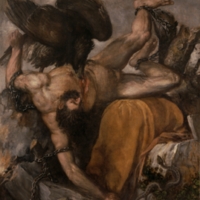
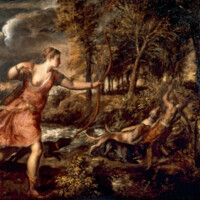
Many Venetian painters found inspiration in classical mythology and incorporated these mythological figures to spread messages within their works. Artists portrayed subjects from mythology alongside conventional Christian themes. Myth and symbols were used in conjunction with each other to mystify and clarify our understanding of the Venetian society. While myths do not convey direct meaning, artists used a balanced composition, effects of light, and vivid colors to create works that blended all these aspects together to spread their message. The mythological stories and figures in Venetian paintings represent figures in Venetian daily life and show ideals, messages, and emotions that Venetians wanted to spread.
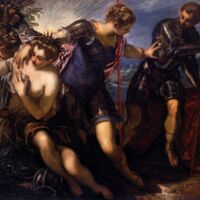
For example, Jacopo Tintoretto’s Minerva Sending Away Mars from Peace and Prosperity (1576-1577) is a political allegory that illustrates the serene republic of Venice that is constantly protected from tribulations like war or disorders [1]. Tintoretto employs contrasting colors and mythological figures to display his message. Tintoretto uses strokes and color hues of white and blue to highlight the left side of the painting where Minerva is seen protecting Peace and Prosperity. Meanwhile, the right side of the painting is characterized by dark shades shown through the black armor of Mars, who is being shielded off by Minerva. The extravagant colors used in the painting illustrate a sense of achievement and power of Venice that is being safeguarded and isolated from war. This artistic representation of Venice is unique in the fact that it uses mythological figures to represent the principles of Venice (peace and prosperity).
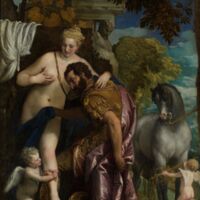
Veronese’s Mars and Venus United by Love illustrates a peaceful, quiet scene where two mythological subjects are being united by love. On the left, the naked goddess of Venus is seen with her arm around Mars, taming him from his fighting endeavors [2]. The nudity of Venus displays her sensual and erotic power. Her other arm is cupping her right breast, from which milk flows, which denotes attributes of nourishment and fertilization. These attributes soften the image and represent central aspects of love and family. The use of two cupids emphasizes how Mars and Venus are putting aside all other hindrances to unify in an eternal state of happiness and accord. The entire scene takes place in a grove and creates a mood of peace and love. The grove gives a sense of an idyllic landscape environment, where this type of impossible engagement can survive [3]. Overall, Veronese creates an undisturbed composition filled with color to show the “forbidden” love affair by two mythological figures that can occur in a city like Venice.
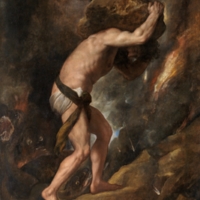
Other paintings like Titian’s Sisyphus and Tityus illustrate important messages that people should not go against the wishes of the gods and heavenly figure or they will face eternal punishment. Overall, this gallery includes Venetian paintings that incorporate mythological figures and stories to help viewers understand important values of prosperity and loyalty while also displaying the magnificence of their city.
1. Jacopo Tintoretto, 1518 - 1594. probably 19th century. The Miracle of Saint Mark. Place: The National Gallery, London, Bequeathed by Lady Lindsay, 1913. https://library.artstor.org/asset/ANGLIG_10313766720.
2. Paolo Veronese (Paolo Caliari), Italian, Venetian, 1528-1588. Mars and Venus United by Love. Place: The Metropolitan Museum of Art, http://www.metmuseum.org. https://library.artstor.org/asset/MMA_IAP_10310749724.
3. Salomon, Xavier F. "Veronese's Skies in S. Sebastiano." The Burlington Magazine154, no. 1315 (2012): 711-12. Accessed November 10, 2020. http://www.jstor.org/stable/41812820.