Gallery 2: Biblical Figures
In Venetian culture, religion played a key role in society and the everyday life of the citizens. Religious allegories and stories were seen through many paintings. During the sixteenth century, new modes of artistic expression came to be in sculpture, paintings, and architecture. Artists began responding to patrons demands of depicting Venetian spectacles and translating new ideas through a Venetian lens. The ideals of the State and the Scuole Grandi were promoted through new forms of arts. Patrons wanted to showcase their prosperity and success while also spreading their beliefs and faith in Christianity. Their use of artistic imagery aimed to inspire and educate society by providing greater clarity of their ideals.
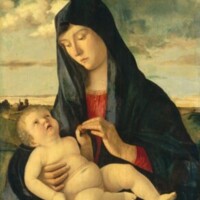
Bellini’s Madonna and Child in a Landscape, painted in the late 1480s, illustrates the Virgin Mary and her baby Jesus [1]. Bellini uses light colors to depict the skin of both the figures while using dark colors for other aspects of the painting including the dark blue cloth draped on Virgin Mary and gloomy shades of green/blue for parts of the landscape like the clouds and grass. By placing Virgin Mary and baby Jesus in a common and informal landscape, Bellini shows how divine beings may live among Venetians [2]. The landscape is filled with vivid shades of green and blue emphasizing the naturalism in the painting. Through this landscape, Bellini shows how Venetians connect to religious beings on a personal level.
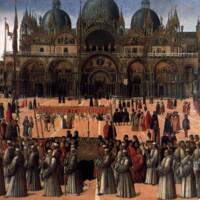
Other paintings used religious figures and events to showcase Venetian spectacles that allowed Venice to fashion an image of themselves as safe and prospering republic. Bellini’s Procession at Saint Marks (1496) documented a festival known as the Feast of Saint Mark [3]. A miracle that occurred on this day relates to a Russian merchant who came to kneel before the relic of the Holy Cross in an effort to save his dying son. The documentation of this civic ritual shows many individuals gathered around the Holy Cross emphasizing the interconnectedness of the urban spaces. The painting underscores the importance of relics as the protectors of Venice and accentuates the mythical qualities of Venice.
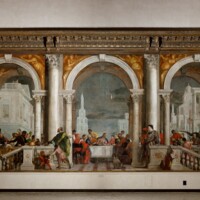
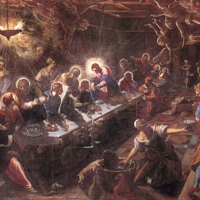
Other paintings in this gallery like Feast in the House of Levi and The Last Supper show the religious spectacles and how it is molded into many aspects of Venetian life. Overall, religion played a key role in how Venice showed themselves to the public and how Venice continued its success.
1. Thomas B. Cole, MD. “Madonna and Child in a Landscape.” JAMA. American Medical Association, December 21, 2011. Accessed September 22, 2020. https://jamanetwork.com/journals/jama/fullarticle/1104741.
2. Helen Cooksey. ""Madonna and Child in a Landscape" by Girolamo Mazzola-Bedoli." Annual Report (Fogg Art Museum), no. 1972/1974 (1972): 58-66. Accessed September 22, 2020. http://www.jstor.org/stable/4301365.
3. Kren, Emil, and Daniel Marx. “Procession in Piazza San Marco.” Procession in Piazza San Marco by BELLINI, Gentile, 2007. Accessed September 12, 2020. https://www.wga.hu/html_m/b/bellini/gentile/miracl1.html.