Browse Items (177 total)
Sort by:
Sisyphus
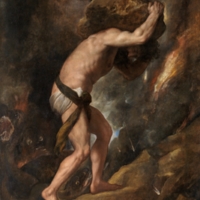
Sisyphus is a painting that depicts an old Greek myth. It was painted by Titian, who completed numerous commissions for mythological paintings including Bacchus and Ariadne, Diana and Actaeon, and the work discussed here, Sisyphus [1].
The myth of…
Tityus
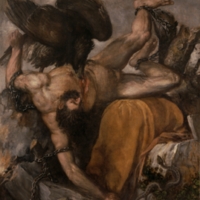
Tityus, sometimes spelled Tityos, is a giant from ancient Greek mythology and the illegitimate son of Zeus and Elara. After attempting to rape Leto, he is killed by the gods Artemis and Apollo and sent to eternal damnation in the depths of the Greek…
Sisyphus
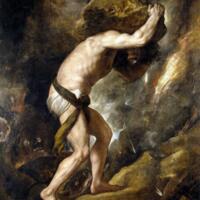
Commissioned by Mary of Hungary for the Binche Palace and painted by Titian c. 1548, Sisyphus documents the story of the King of Corinth, Sisyphus. Sisyphus was condemned to push a boulder to the top of a hill in the Underworld repeatedly, for the…
Saint Margaret and the Dragon
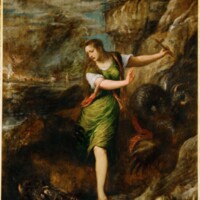
In this painting, we see Saint Margaret, an Antioch virgin, emerging from a dragon’s severed body with a cross in hand. Titian makes Margaret the central figure in the painting in multiple ways. First, he makes her skin and clothing have much…
The Bacchanal of the Andrians
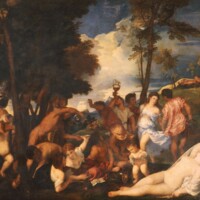
Titian was commissioned to create this painting for Alfonso d’Este. This painting demonstrates the joy brought to the people from wine. Clearly, a wine glass is being held in the center of the painting to demonstrate the immense focus Titian places…
The Worship of Venus
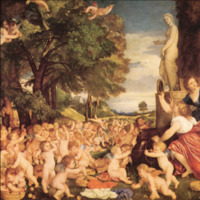
Titian, a highly revered artist of the Venetian Renaissance, was commissioned by Alfonso I d’Este the Duke of Ferrara to work on a series of paintings for the Alabaster Chamber. The collection had a Dionysian theme and included The Worship of Venus,…
Virgin and Child with Saints Dorothy and George
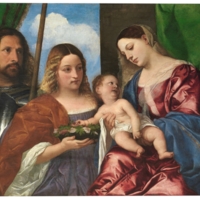
Titian, or Tiziano Vecellio, first gained popularity for his religious pieces and for applying the colorito technique and providing innovative twists to classical interpretations of biblical stories, such as in The Virgin and Child with Saints…
Christ Carrying the Cross
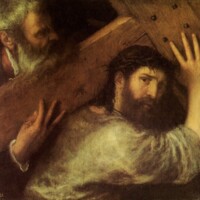
Titian’s Christ Carrying the Cross was not a one off subject matter or commission. Several decades prior Titian had created a version of Christ Carrying the Cross depicting Christ tied at the neck by the rope of an executioner [1]. This work was…
Saint Margaret and the Dragon
Titian created Saint Margaret and the Dragon in ca. 1565 and it is currently in the Museo del Prado in Madrid, Spain. Philip II owned two paintings of this saint: one remains of the Escorial, which came in 1574, and the version in the Museo del Prado…
Venus and Adonis
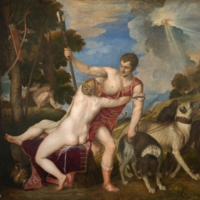
The scene of Venus and Adonis comes from the literary work The Metamorphosis by Ovid. After being mistakenly hit by an arrow from Cupid, Venus, the goddess of love, became the lover of the mortal young hunter Adonis. Venus had a foreboding that…