Browse Exhibits (17 total)
Backgrounds in Venetian Paintings
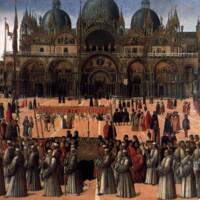
In many ways, every painting, drawing, and artistic composition exhibit similar characteristics. Spanning the millions upon millions of paintings created by people all across the world, there are a few compositional elements that can be consistently identified. Almost every painting is divided into two (and sometimes three) different parts. These labelings are referred to as the foreground, middle ground, and background. While the foreground is the main draw of the viewer's attention, often exhibiting the “action” or excitement of the work, its counterpart plays an equally important part. The background is considered the matrix of a painting, holding the main subject to the viewer’s focus [1]. Broken down into its most basic form, the concept can be illustrated as a balance between positive and negative space. Positive space is the main subject of the painting, while negative space is the area between the subject and the rest of the scene [1]. Most importantly, a background provides shape to the main scene. For example, suppose one paints a grey object onto a grey canvas. Since they are the same color and create no delineation between the foreground and background, the image is simply a series of defined edges [1]. This makes the contrast in color between the two parts of an image crucial to demonstrating a focus.
When considering backgrounds in terms of landscapes, the primary purpose lies in establishing depth within a painting. The perspective, hue, value, intensity of the color, and placement of objects are critical to the organization of a background [1]. Combining these elements either strengthens or weakens the realism of an image, depending on the artist’s intention.
The background can complement and supplement the foreground subject, an effort to provide context and explain the setting to the viewer [2]. Some artists make their backgrounds intentionally detailed, with plenty of textures and bright colors, while others make backgrounds vaguer and with muted tones. While each style is perfectly acceptable, they achieve different effects. When creating backgrounds, artists may ask themselves, “What does the viewer need to know? What is the focal point of my creation? What point of view does the capture take?” For each work of art, the answers can vary greatly.
Venetian art, under my interpretation, exhibits two main forms of backgrounds. Venetian artists use the natural landscape and the architectural landscape to establish context and demonstrate themes and values within their works. In the two galleries in this exhibit, one will understand how each is used and the purpose they fulfill.
[1] Goodnight-Melbourne, “A Discussion On Backgrounds In Paintings,” Deviant Art, January 21, 2015, https://www.deviantart.com/goodnight-melbourne/journal/A-Discussion-On-Backgrounds-In-Paintings-505684319.
[2] Artists Network Staff, “The Importance of the Background,” Artists Network, January 29, 2008, https://www.artistsnetwork.com/art-mediums/watercolor/the-importance-of-the-background/.
Biblical allegories and symbolism in Venetian Art
Venice, a celebrated city known for its exceptional quality of artworks. It was a pious city from the early Renaissance period and Venetians had a strong belief in God. Religious faith in Venice was highlighted through many mediums such as paintings in the churches and decorative productions that emphasized Venetian piety. Furthermore, traces of Venetian history were embedded in those painting as well. Paintings in Venice goes outside the limitation of just blotches of colors, it is a full story on its own.
During the wake of the art Counter-Reformation, many artists start to shift the focus within the painting from mere portraits of holy figures to more of a story or scene. Venetian artists back in the 15th to 17th century will use artistic elements to convey the story of biblical allegories and stories along with symbolism. Most of the time, when an artist adds some abstract elements within the painting, they usually have some meaningful purposes beyond just decorations. Indeed, paintings are different from books, the painter often has to think about how to convey a story and its background history within the painting. Perhaps, sometimes even the most common decorations in the painting may represent other things. If the painting is a biblical allegory, it will most likely to adopt symbolism from the bible [1]. Or a simple facial expression may hint at the theme of the story in the painting. As a matter of fact, this almost demonstrates how carefully each artist has to reflect on the scene within the painting and the amount of attention paid to each detail. As a result, every painting will also require the viewer to examine every detail carefully in order to grasp the message conveyed from the paintings.
[1]Bernhard Ridderbos. "Antonello's 'Saint Jerome in His Study'." The Burlington Magazine 124, no. 952 (1982): 449. http://www.jstor.org/stable/880731.
Classical Mythology in Venetian Arts
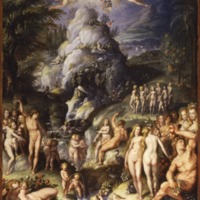
New interpretations will always be invited by myth, and this has caused it to be reinvented for each century. [1]The God of the ancient world has remained an integrated component of Venice's common language, an expression transmitted throughout history by artists and viewers. It can appear implausible and bewildering to the tales themselves. From violence to ecstasy, from cruelty to sadness, from a simple desire to romantic love, the spectrum of human emotions they discuss is very wide. The myths are also "socially powerful": what this suggests is that they react to things that are profoundly related to cultural and religious values, [2] as well as the delivery of political knowledge about society. In the following three art galleries, a number of paintings containing classical mythological figures and elements created by Venetian artists for domestic and foreign art commissioners are covered.
[1]Brenner, Carla McKinney, and Julie Warnement. “Myth and Audience.” Introduction. In The Inquiring Eye: Classical Mythology in European Art: Teaching Packet, 5–8. Washington, D.C.: National Gallery of Art, 1996.
[2]Buxton, R. G. A., and David Fitzpatrick. Bryn Mawr Classical Review, November 29, 2004. https://bmcr.brynmawr.edu/2004/2004.11.29/.
Colorito - Venetian Use and Importance of Color
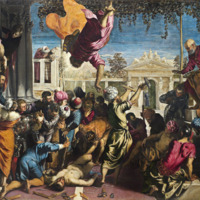
Venetian artists worked voraciously to compete with other artists during their time period, as well as to follow the footsteps of the greatsd before them. These artists achieved this mainly by creating works that would be admired for their religious glorification, pure beauty, and naturalistic features. Another key feature of Venetian artwork was the emphasis placed on color. The phrase "colorito" translates to "coloring", and is typically used to describe the how Venice artists exemplified their mastery of color pigments and tones in their paintings. In 16th-century Venetian paintings, color was used in a dominant manner. This served for the artisits's expressive purposes and as an important compositional element. The manipulation of color allowed for raw emotions to be poured onto the canvas. Artists such as Titian, Veronese, and Tintoretto devloped a unique relationship and rivalry during this time period, all three of which were strong advocates of using colorito as a central compositional element. The main alternative to colorito was "designo", which favored the art of drawing over colorism. Artists from different areas of Italy represented nature quite differently which led to artwork that differed not only in technique and appearance but in their very conception. Designo was much more popular in Florence, Italy, as opposed to the love of color in Venice. To the Floretines, art was drawings and shaped with the addition of color, whereas the Venetians saw art as drawing fused with color. This demostrates the higher emphasis and Venetians placed on color. In Florence and other parts of Italy, color was essentially an added bonus to the drawing itself, but in Venice it was seen as an inseperable and key component of the final piece. Another key difference between these techniques was the fact that the Florentines were planning and perfecting their design on paper, the Venetians were instead drawing straight on the canvas. They would alter their design while painting, thus focusing on the brushwork and color that they were applying directly onto the canvas. All in all, in order to implement colorito in Venetian paintings the process of layering and blending colors was often used to achieve a glowing richness. This demonstrates the fact that not only the selection of colors, but also the way these colors were applied was deemed fundamental to conceiving painted images charged with the true look of life. This marked a shift from previous Italian art and it is one of the many factors that made Venice such a unique and distinct cultural hub.
Evolution of Venetian Artist

Venetian art has revolutionized dramatically throughout the 14th, 15th, 16th, 17th, and 18th centuries. This style of art was a major force during the Italian Renaissance paintings and a guy by the name of Paolo Veneziano started it all off. Venetian art was developed based on Western paintings. The first form of Venetian art was seen in the 14th century when the frescos were commissioned to be painted in the Doge’s Palace. Going into the 15th-century art transitioned from Italo Byzantine style to an International Gothic style. Venetian art revolutionized mainly through three artists named Giovanni Bellini, Titian, and Tintoretto. Giovanni Bellini is credited for the overall creation of the Venetian style of art. In fact, the Bellini family was one of two major dynasties in this century. The other major dynasty belonged to the Vivarini family. Titian was known as the most successful member of the Venetian art school and it showed throughout his works during his time. Titian produced several great works of art ultimately earning the title of the most influential Venetian painter. He became versatile and specialized in portraits, mythological subjects, and landscapes. Tintoretto emerged for the amazing energy he painted with and the boldness seen in his paintings. His work features overly dramatic gestures and muscular figures. He was also a graduate from the Venetian school.
Female Depictions of Divinity and Protection
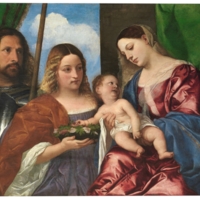
Venice may have originated from a marshy, inhospitable lagoon, but it quickly rose to become a central religious authority, a culturally vibrant center, and a worldwide economic powerhouse. [1] Through various forms of artistic developments, interactions, and commissions, Venetians celebrated this aspect of their city’s history through the ideals that they spread to both Venetians within the republic and to the world at large. This was especially true during the Early Modern period in Venice where numerous artists competed for commissions from the city’s various scuole, the patrician class, and the Venetian government to perpetuate the concept of La Serenissima—the most peaceful and prosperous republic of Venice. [2]
One facet of the mysticism surrounding Venice was the notion that Venice was granted divine protection particularly stemming from the Virgin Mary. According to legend, Venice was founded on March 25, on the day of the Annunciation, in the year 421. [3] As a result, Venice has perpetually seen itself as connected to the Virgin Mary herself and believed her to be a conduit of God’s protection of Venice. This notion is further perpetuated by Venetian’s belief that Venice was a city beloved by God, who had raised it from the sea as a symbol of Christian ideals. [4] Ultimately, these factors coalesced to perpetuate Venice’s self-identity as a divinely protected city, and, specifically, one protected by a female divine figure.
Furthermore, due to the Greco-Roman revival prominent during the Early Modern Period, there were also numerous instances and imagery that included mythological figures as well. This aspect is clearly evident in famous pieces like the View of Venice by Jacopo de Barbari, which included the figures of Jupiter and Neptune with inscriptions declaring their protection over Venice. [5] However, protection by pagan gods was not limited to the male deities, as there were numerous depictions of Roman goddesses, such as Minerva and Diana, acting in roles of power and protection.
This exhibit highlights the ways in which women were depicted in roles of divinity and protection, not only within the realm of the Christian religion but with consideration of mythological figures as well. It also provides a glimpse into the ways women were not seen as divine or as protectors and the balance that is struck between both roles and interpretations for Venetian women.
[1] David Rosand, Myths of Venice: The Figurations of a State (Chapel Hill: University of North Carolina Press, 2001), 6.
[2] Richard Goy, “Venice,” Grove Art Online, (2003): 5-8, https://doi.org/10.1093/gao/9781884446054.article.T088612.
[3] David Rosand, Myths of Venice: The Figurations of a State (Chapel Hill: University of North Carolina Press, 2001), 12.
[4] David Rosand, Myths of Venice: The Figurations of a State (Chapel Hill: University of North Carolina Press, 2001), 13.
[5] Deborah Howard, “Venice as a Dolphin: Further Investigations into Jacopo De’ Barbari’s View,” Artibus Et Historiae 18, no. 35 (1997): 101-11.
Greco-Roman Footprints in Venetian Art

Greco-Roman mythology has provided the world with great fables and tales, highlighting heroes as they journeyed on their quests, as well as the many divine figures and their stories. Through devotion and careful study, the Greeks and the Romans looked to their mythology for guidance as they built the great Classical civilizations that modern society recognizes. However, in addition to Greco-Roman society, the Republic of Venice during the Early Modern period also utilized Greco-Roman mythology as a foundation, building upon it to create La Serenissima--the Most Serene Republic.¹
As Venetian society further developed, so did its depiction of mythological subject matter in art. Ranging from allegories to personal status development, art pieces depicting mythological subject matter became much more adaptive, serving a wide spectrum of purposes. Many famous artists, such as Titian, Tintoretto, and Veronese, used mythological subject matter to depict various images.
This exhibit will offer the opportunity to explore the functions of these adaptations of mythological subject matter within Venetian society. More specifically, this exhibit will explore how mythological subject matter was used to give insight into the self-perceived appearance of Venice², as well as the reality of Venetian society during the Renaissance.
- John Foot and Denis E. Cosgrove, “Venice,” Encyclopædia Britannica (Encyclopædia Britannica, inc., April 23, 2020), https://www.britannica.com/place/Venice.
- Deborah Howard, “Venice as a Dolphin: Further Investigations in Jacopo de’ Barbari’s View,” Artibus et Historiae, (1994), 101-11.
Landscapes in Venetian Art During the Renaissance
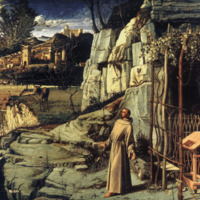
The landscape of a painting consists of natural elements: trees, valleys, mountains, rivers, and other non-natural structures. All these components are arranged into a coherent composition to create an intricate scene that covers the canvas. Many paintings in the earliest ancient and Classical periods included elements of natural features but it was not considered its own independent genre [1]. Landscapes as a genre was not distinguished in European art until the Renaissance. Medieval Age art laid emphasis on the figures and paid little attention to the setting that they were placed in [2].
Landscapes began to emerge as a more explicit feature in Venice in the late fifteenth century as backgrounds became more and more detailed. During the Venetian Renaissance, the great artist Giovanni Bellini emerged as an illustrious painter. His religious subject matter was often complemented by a scene of natural wonders influenced by the watery topography Venice provided and its unique parade of color and light. Bellini transformed traditional religious paintings into alluring depictions of the Venetian mainland all while keeping with the ideas and motifs of the Counter Reformation happening during this era [3]. Bellini’s unprecedented work set the stage for his pupils, Titian and Giorgione, to continue and further evolve the development towards this element as an independent genre.
This exhibit offers the opportunity to explore the development of landscapes throughout the Renaissance by these three prominent artists, how their ideas influenced novel works and were exchanged between one another, and how the commissioners and patrons of their work affected their individual style. None of these artists painted a landscape as an end in itself, but their role played a major part in the process of developing this genre into a recognized mode of artistic expression.
1. Naomi Blumberg, “Landscape Painting,” April 3, 2020, https://www.britannica.com/art/landscape-painting.
2. “Landscape in the Renaissance,” Landscape in the Renaissance (Getty Center Exhibitions), accessed November 12, 2020, https://www.getty.edu/art/exhibitions/landscape_renaissance/.
3. “Giovanni Bellini: Landscapes of Faith in Renaissance Venice: Getty360 Calendar,” The J. Paul Getty in Los Angeles, October 10, 2017, https://www.getty.edu/visit/cal/events/ev_1730.html.
Mythological and Biblical Figures Through a Venetian Lens
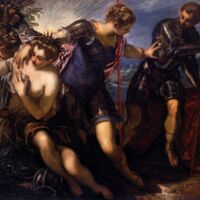
This exhibit will explore how Venetian art portrayed mythological and biblical figures to spread Venetian ideas and ideals. There has always been a lingering notion of Venice as a magnificent city that was blessed by Saint Mark and had a balanced constitution that included republican liberty. Throughout its history, Venice has carefully molded an image of themselves as a magnificent city built on water. Venice distinguished itself through its unique artistic expression, style, and influence. As Patricia Fortini Brown touched upon in The Ceremonial Welcomes of the Venetian Republic, Venetians would maintain a proper balance of showing off the real, while maintaining the illusion through different forms of self-presentation [1].
Many paintings illustrated Venetian ideals and values like justice, wisdom, protection, and fairness that Venice followed throughout its successful times. The use of mythological and biblical figures allowed Venetian artists to use heavenly and god-like figures to emphasize the important messages of the State and Scuola Grandi. During times like the Counter Reformation, which was a period Catholic resurgence, Venetian art reflected prevailing ideals of Catholicism [2]. Mythological and biblical figures became central subjects for painters like Titian, Paolo Veronese, and Jacopo Tintoretto, whose artistic rivalry was known as prime motivation for these artists.
These subjects were allegories of the resurrection of the soul, the triumph of virtue over evil, the importance of loyalty to the Venetian saints, and continued to provide material for artistic representations of important events and moments that Venice wished to share with the public. By exploring these paintings, we can gain a better understanding of how Venice mythologized their city and how Venetian ideals allowed them to have peace and prosperity during the Renaissance.
1. Patricia Fortini Brown, “Measured Friendship, Calculated Pomp: the Ceremonial Welcomes of the Venetian Republic,” in All the World’s a Stage, ed. Barbara Wisch, pp. 136-50.
2. Kurtzman, Jeffrey G. "Lessons Learned from the Iconography of Venetian Ceremonies: Claudio Monteverdi and "trombe Squarciate"." Music in Art 32, no. 1/2 (2007): 113-32. Accessed November 4, 2020. http://www.jstor.org/stable/41818809.
Power through Religious and Secular Art
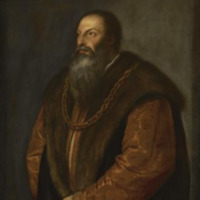
An exhibit exploring Venetian artists' and their patrons use of painting to project power both through religious allegories and secular portraiture.