Biblical Women
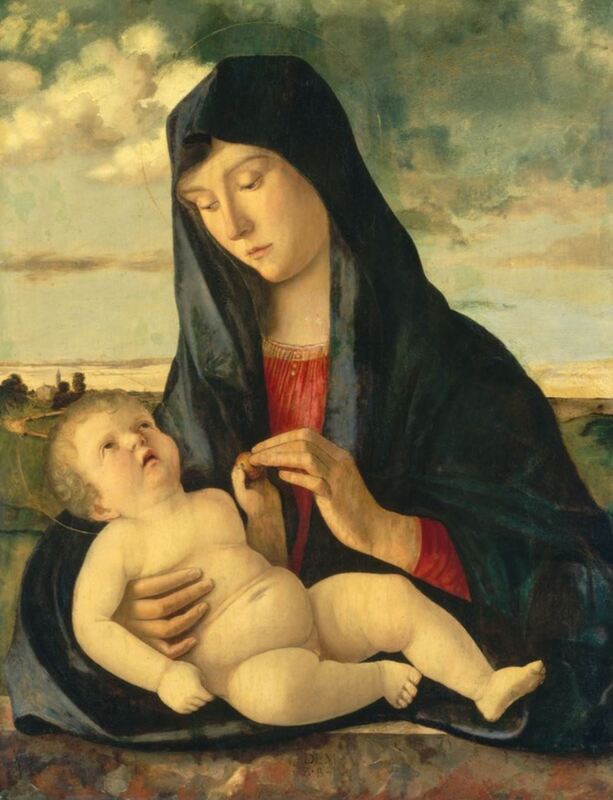
Thanks to the foundation of Venice being on the day of the Annunciation, the Venetian people felt a special connection to the Virgin Mary. [1] As a result, she is often the content of numerous religious paintings, such as this one by Giovanni Bellini in the year 1480. This piece, known as Madonna and Child in a Landscape, renders the Virgin Mary in a naturalistic way by utilizing a manipulation of light and creating a placement of environmental symbols, such as trees and a large sky, around her. This was done in order to help the people of Venice better connect with one of their key religious figures. By making the Virgin Mary appear more human, especially in a scene as intimate as one between a mother and a child, Bellini fosters a sense of pathos that pulls at the emotional strings of the viewer and builds a sense of understanding and connection. Though the artist wishes to help people connect to an important figure in Venice’s religious authority and divine protection, however, the artist still reminds viewers of her separation and distinction from them due to her divinity and unique connection to God. This distinction helps emphasize her role as not only a mother but a protector as well.
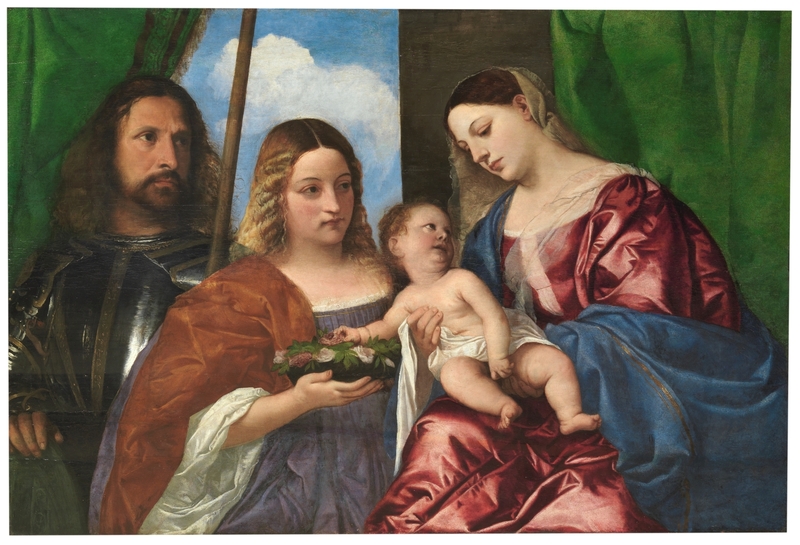
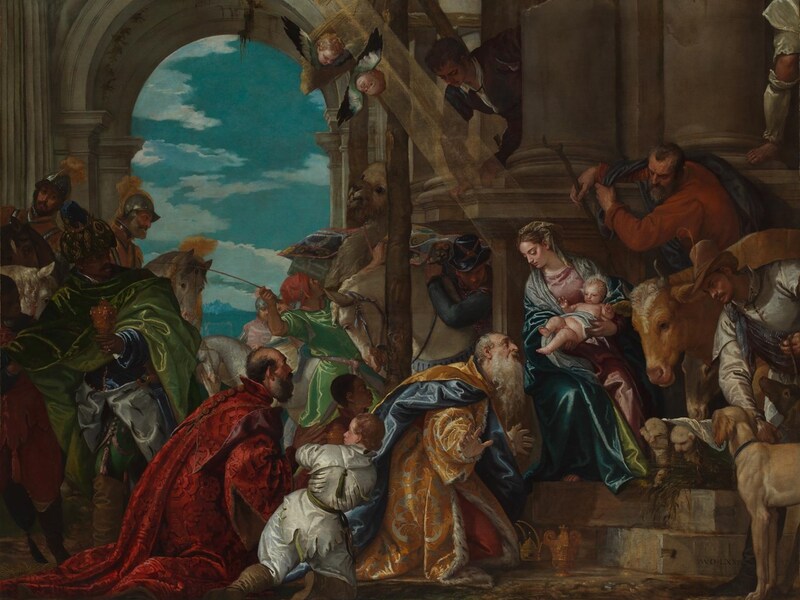
The theme of the Virgin and Child was as popular as she was important to the Venetian people. However, she is often depicted with other individuals in the scene rather than alone. For instance, Virgin and Child with Saints Dorothy and George by Titian circa 1515 to 1518 includes the figures of other saints in order to emphasize the importance of the Virgin Mary. Particularly, in this piece, Titian utilizes light, by solely illuminating the face and figure of the Virgin, and form, by making the figure of the Child Jesus as well as the figures of the two saints appear to be facing towards the Madonna. This creates an emphasis on the Virgin Mary as the central figure and celebrates her role as a protector of not only the Child Jesus but of Venice as a whole. Other pieces more directly illustrate her connection to Venice through more clear symbolism of the day of the Annunciation, such as in Veronese’s Adoration of the Kings, which was painted in 1573. This piece, similar to the rendering by Titian, utilizes light and spatial positioning to place the figure of the Virgin Mary in a role of authority and importance, however, it goes further to provide distinct symbolism that connects her to the day of the Annunciation itself. The inclusion of individuals, such as the three kings who had visited the Child Jesus after He was born, as well as architectural and symbolic features, such as elements of a barn and barn animals, both of which allude to this scene as being the narrative of the Annunciation. This served as a visual representation of the Virgin Mary’s connection to the natural world, and, specifically, to Venice itself.
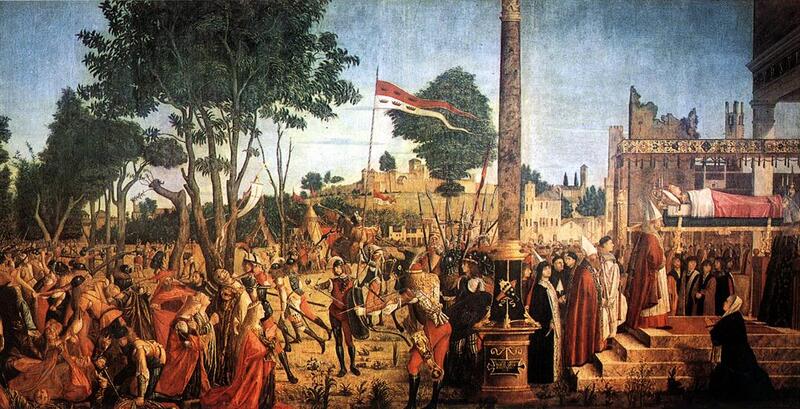
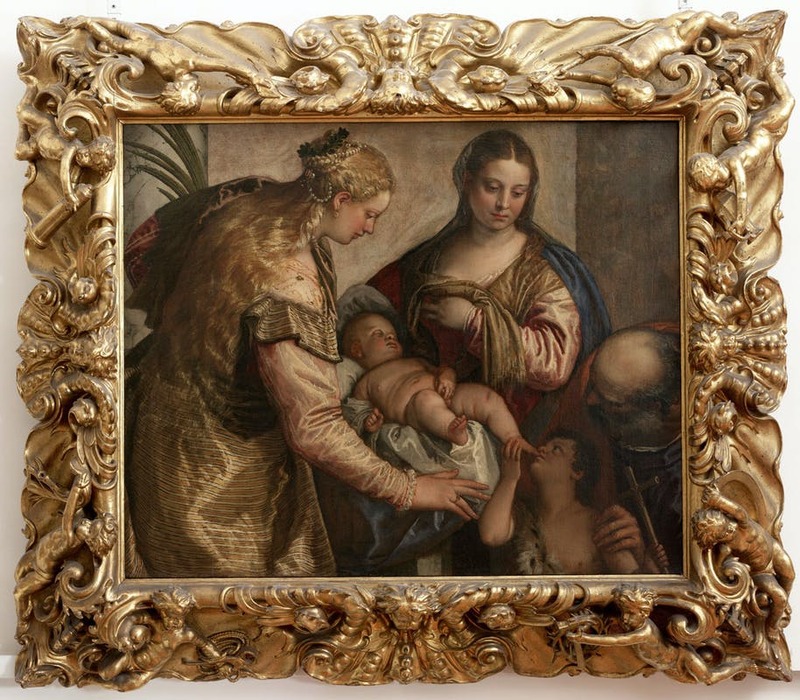
Beyond depictions of the Virgin Mary, there were also numerous depictions of female saints in roles of protection and divinity within Early Modern Venetian art. One such piece is Martyrdom of the Pilgrims and the Funeral of Saint Ursula by Carpaccio in his cycle of the life of St. Ursula. In this piece, Carpaccio utilizes a tightly packed spatial organization, an enlarged form of the figure of St. Ursula as well as the physical elevation of Saint Ursula to place her as a direct actor in this scene rather than a passive observer. She is portrayed as an active agent who deliberately chooses an untimely death in order to live by and protect her Christian ideals. By protecting Christianity in this manner, she is marked as a model and example of Christian piety. Another piece that includes a depiction of a female saint in a role of protection is Holy Family with a Young Saint John and Saint Catherine by Veronese in 1565. Veronese applies color in a manner to draw the eye towards Saint Catherine and accentuate her in this piece. He, then, depicts her form in a manner that makes her appear to be standing protectively over the figure of the Child Jesus. This furthers the notion that Saint Catherine was also seen and depicted as a protective, divine figure.
As a whole, Venetians saw the Virgin Mary as a protector because she was specifically chosen by God to carry a Savior to redeem and save humanity, which, along with the connection between her and Venice’s foundation, led to them adopting her as a special protector of Venice. [2] However, she was not the only depiction of biblical women that were considered divine protectors. As seen in the artwork above as well as in a broader theme throughout Early Modern Venice, many female saints were depicted in a role and position of active choice and protection as well.
[1] David Rosand, Myths of Venice: The Figurations of a State (Chapel Hill: University of North Carolina Press, 2001), 12.
[2] David Rosand, Myths of Venice: The Figurations of a State (Chapel Hill: University of North Carolina Press, 2001), 13.