Mythological Goddesses
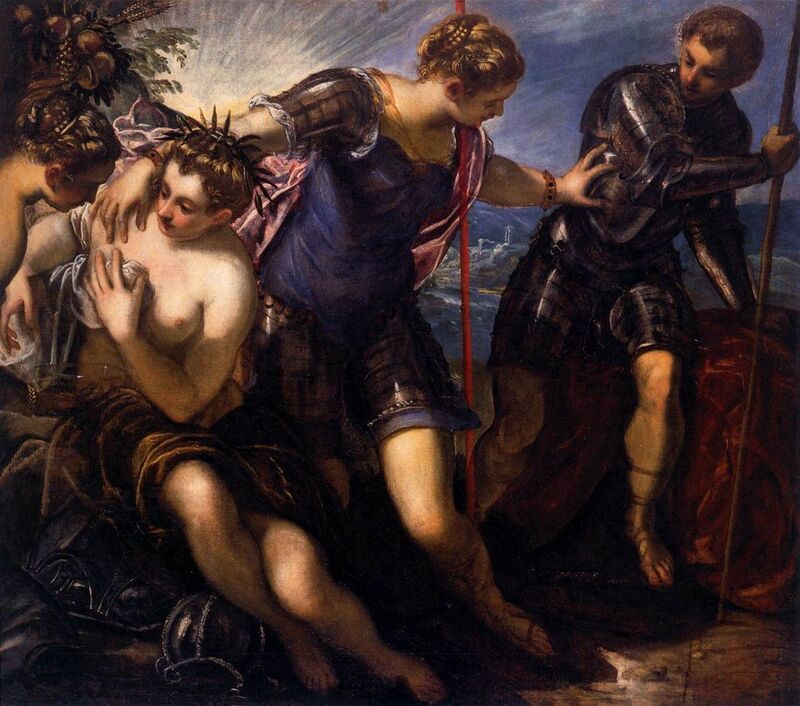
Thanks to the revival of classical antiquity, biblical women were not the only instances of female protection in Venice. Numerous mythological goddesses, particularly from Roman influence, were depicted in scenes that promoted their divinity and their ability to protect. One of the most direct portrayals of this idea is Minerva Sending Away Mars from Peace and Prosperity by Jacopo Tintoretto for the Ducal Palace. In this piece, he utilizes uses heavy forms set in a forward plane in order to control the spatial recession of this piece as well as ornately decorated relief-like frames to add a sense of drama and emphasis to this piece to catch the viewers’ eyes. [1] Particularly, he is dramatizing the role of Minerva as a protector in this scene as she directly protects Peace and Prosperity. However, this dramatization offers a political allegory of Venice’s ideals. [1] It conveys that Venice values the ideas of peace and prosperity over the idea of war, as represented by Mars in this scene, as well as the notion that these Venetian values are being protected by this mythological Goddess.
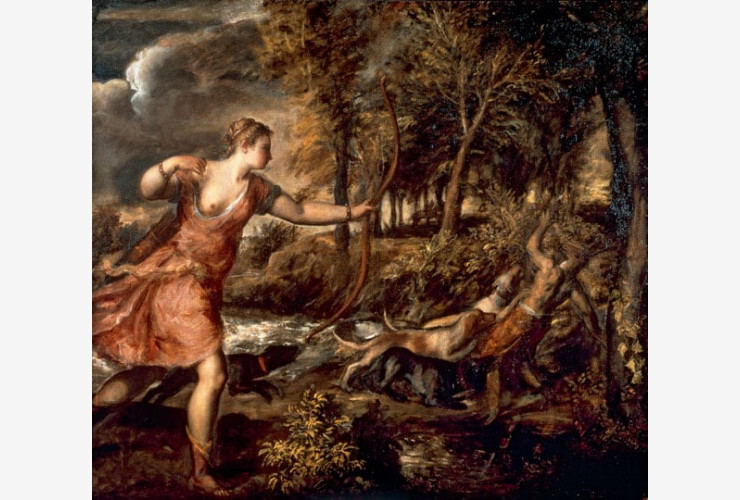
Similarly, the Roman goddess, Diana is depicted in a scene of dynamism and action in The Death of Actaeon by Titian for King Phillip II as a part of a cycle called “Poesie”. [2] Titian creates a dichotomy between the animal figure of Actaeon and Diana hunting him through the use of light, coloring, and environmental elements, such as the trees and water in the background, to create a separation between the mortal, profane world of Actaeon and the divine world of Diana. By rendering Diana’s form in a state of motion as well as with protective elements, such as a bow and arrow, he paints her as a divine and protective figure. In this piece, this protection occurs in the form of justice by killing Actaeon for his error, and the idea of protection in the form of justice is reflective of the Venetian principle of la Serenissima being protected by justice and fair governance.
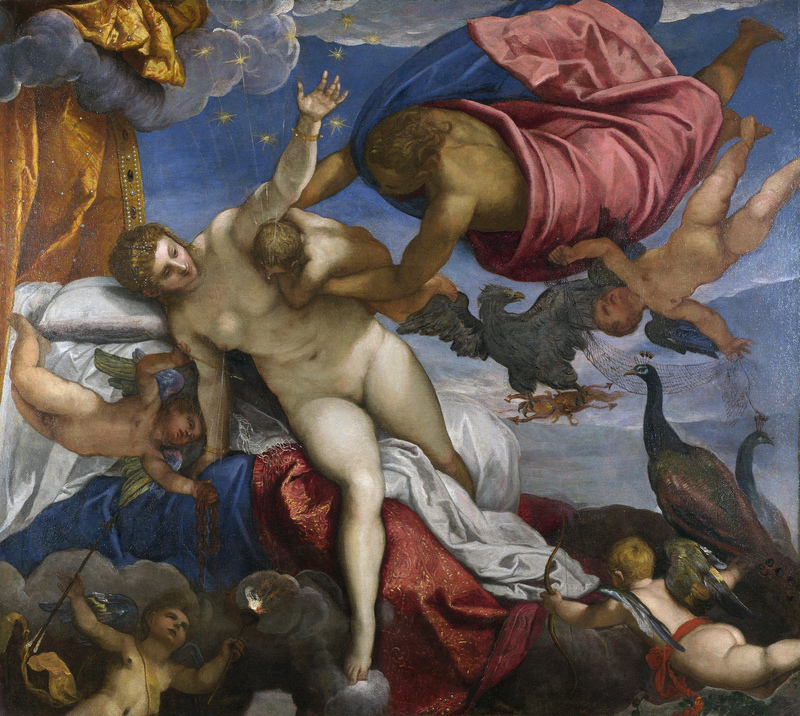
These two goddesses are not the only mythological sources of female divinity and protection. In Tintoretto’s Origin of the Milky Way, which was painted in 1577 and depicts the story of one of Jupiter’s marital indiscretions. Here, Tintoretto utilizes color, form, and spatial organization to place Juno as the key figure in this piece. He also utilizes symbolic elements, such as the stars floating from Juno’s breast as well as the rich fabrics around her to tell the mythological story of this piece. Here, Juno is established as a source of power because it is her milk that can gift immortality. Furthermore, her milk is also the source that creates the beautiful stars that float up towards the heavens as well. By portraying Juno so centrally in this piece, Tintoretto is reminding his viewers of the power that Juno possesses. Her ability to give immortal life as well as create beautiful stars helps place her as a protective figure, which is how she was known throughout mythology. [3]
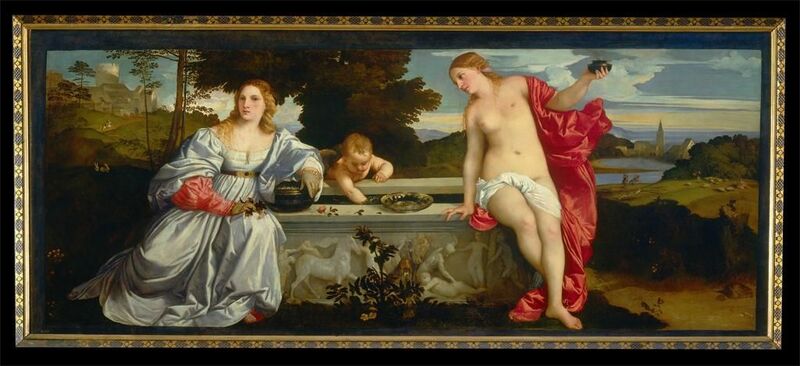
Similarly, Sacred and Profane Love by Titian, though includes a depiction of a mortal woman, also depicts a divine, mythological goddess. Particularly, the nude woman on the right is a depiction of the pagan goddess Venus. Throughout this piece, there are numerous elements that are symbolic of fertility and marriage, such as rabbits and the lush environment. These symbols are a reminder that the source of women's power in Venetian society came from their roles as wives and mothers. With Venus, it shows her power in terms of fertility and establishes her as a divine protector in these terms.
Through the popularity of Greco-Roman antiquity, various artists throughout Venice establish the idea that Greco-Roman goddesses could act as protective figures as well. By depicting the pagan goddesses in these Venetian works of art, artists like Titian and Tintoretto are reminding viewers of these goddesses’ connection to Venice in the role of protection.
[1] Thomas Nichols, “Tintoretto Family [Robusti],” Grove Art Online, (July 2012): 2-3, https://doi.org/10.1093/gao/9781884446054.article.T085169.
[2] Cecil Gould, “Titian”, Grove Art Online, 2003: 17, https://doi.org/10.1093/gao/9781884446054.article.T085242.
[3] Mike Corbishley, Ancient Rome, (Warwick Press, 1986), 62.