Leaving Legacies through Stories of the Past
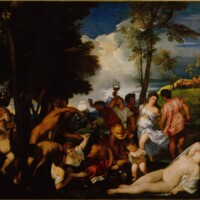
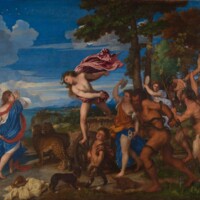
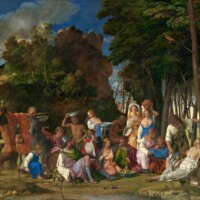
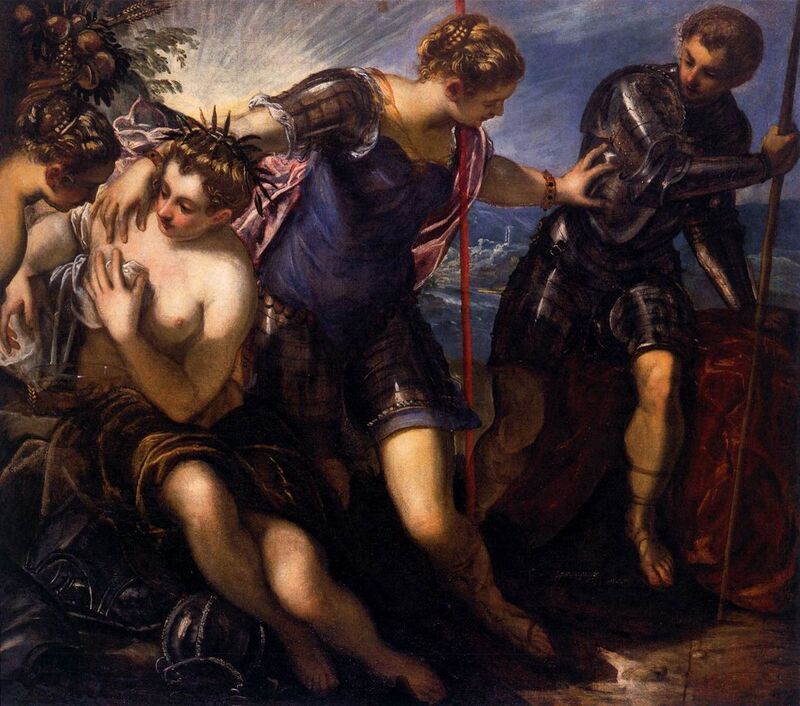
While Venice as a whole flourished in its newfound myth, many patricians--the top 1% of the population who held government seats--saw an opportunity to cement themselves within the grand history of Venice. Although self-promotion and a focus on individualism was frowned upon in favor of harmony, opportunities presented themselves to patricians as artists began to compete for fame and glory. In a similar manner to how Venice promoted itself, patricians sought to associate themselves with favorable attributes of Greco-Roman mythology and thus associating themselves with the awe-inspiring myth of Venice in the process. Tintoretto’s Minerva Sending Away Mars from Peace and Prosperity depicts this process brilliantly; celebrating the successful nature of Venice under his reign, Doge Girolamo Priuli commissioned this piece which uses mythological subject matter to create a metaphor¹. As Minerva sends Mars--the god of war--away from Peace and Prosperity, it symbolizes how Doge Priuli kept war away from the tranquility of Venice. It also displays the Doge as an important high authority, as his equivalent in the painting is Minerva--the goddess of wisdom.
Foreign royalty, becoming aware of this, also took an interest in fortifying their legacy, hiring Venetian court artists, such as Titian, to create pieces of art with similar functions and subject matter. The other three paintings shown--Bacchus and Ariadne, The Bacchanal of the Andrians, The Feast of the Gods--were commissioned to Titian by Alfonso d’Este, duke of Ferrara. This cycle was part of his private collection, intended for his studiolo². Within these paintings, rich materials, such as aquamarine, were used to depict different aspects of the commissioners, emphasizing the immortality and power of his lineage. This, combined with the depictions of mythological subject matter, lodged the commissioner within the roots of history, immortalizing himself and his family.
- W. R. Rearick, "Venice. Palazzo Ducale and Libreria Marciana," The Burlington Magazine 123, no. 944 (1981): 699-703, http://www.jstor.org/stable/880557.
- David Bull, "Monograph Series II: The Feast of the Gods: Conservation, Examination, and Interpretation," Studies in the History of Art 40, (1990): 3-106, Accessed September 22, 2020. http://www.jstor.org/stable/42621814.