Social Dynamics in Renaissance Venice
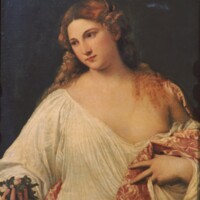
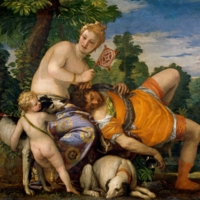
While many paintings created with mythological subject matter had a purpose of promotion (among many other purposes of course), many paintings also, intentionally and unintentionally, projected social principles of Venetian society. Although there are many paintings that focus on the males of Venice, this section will focus on the social dynamics of women in Venice. Venetian society was created in a manner that no amount of female wealth or power could dissolve the male control over Venetian social institutions¹; thus, because Early Modern Venice was a patriarchal society, there is a greater interest here in understanding the role of the woman in this society--or rather, the way that women were seen by society. Through these images containing mythological subject matter, one can see what the ideal Venetian woman was.
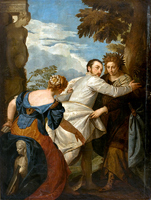

One major theme surrounding the Venetian ideal woman was the concept of marriage, specifically the role of the woman in the relationship. As seen in Veronese’s Mars and Venus United by Love, Venus calms Mars, who sacrifices his violent nature to be with his lover. Thus, through the depiction of mythological scenes, we see how Venetians saw marriage as a bond that required sacrifice, strength, tranquility, and transparency, despite the inferior social status of the woman. This inferior status can be seen in the erotic manner by which Venus cups her breast, appearing as a plaything--much like how men saw women in Early Modern Venice.
This erotic depiction is also seen in other paintings. In this exhibit, we also see this in Venus and Adonis and Flora. Through these images, we see the social disparity between man and woman, one that seen through the modern lense would seem offensive, but through the Renaissance lense would seem normal.
In addition, we see the fashion of the time period expressed: various gods and goddess wear Classical clothing that has been adapted to Venetian society². Many figures adorn jewelry such as pearls, gold, and precious stones. Thus, one can infer that these representations of women may most likely be of those who were part of/married into patrician families with great wealth, and thus, great social status.
- Stanley Chojnacki, Women and Men In Renaissance Venice: Twelve Essays On Patrician Society, (Baltimore: Johns Hopkins University Press, 2000) https://hdl.handle.net/2027/heb.04157. EPUB.
- Emma H. Mellencamp, "A Note on the Costume of Titian's "Flora"," The Art Bulletin 51, no. 2 (Jun 01, 1969): 174.