Gallery 2 - The Landscape's of Titian
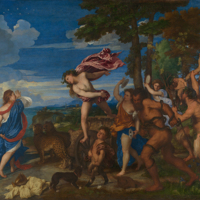
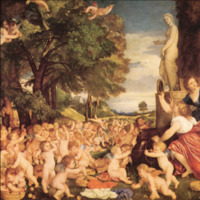
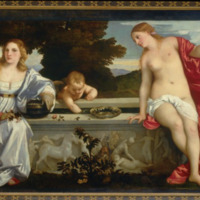

Titian’s landscapes embraced figures of religious importance as well as mythological subjects as Titian had commissions from a wider variety of clients than that of Bellini. Titian painted things ranging from high altars to painting for a specific room in an estate which very much influenced his works and allowed him to venture into subject areas Bellini did not. His landscapes are less focused on the landforms as a device to help compose paintings, but utilized the sky and natural verdure instead.
Titian’s landscapes were ever changing throughout his career and were heavily influenced by who he was painting for. The mythological paintings done circa 1520 for the Duke of Ferrera, Alfonso d’Este, were much more joyous in composition and the landscapes were vivid [1]. Seen in both Bacchus and Ariadne and The Worship of Venus, Titian uses the landscape in these paintings as a compositional factor as well as a way to amplify the actions of the figures. The foliage seen in these paintings is greater than that seen in any of Bellini’s previous works. The sky made of bright colors really separates the foreground and figures from the heavy foliage of the background. He creates a harmony between the environment and the figures living in it. Sacred and Profane Love provides great evidence of how Titian uses the sky as a compositional device, the clouds create a feeling of spaciousness as well as add to the design element. Danaë’s landscape is much more hazy, and less detailed than that of his other works. However, he still includes a sky and hazy countryside as the use of those colors help compose the painting in a diagonal fashion. As a Venetian painter of a large number of works, many of which are notable, Titian’s landscapes differed from one to the next but continued to evolve the genre further with great skill and in a unique manner.
1. Warren D Tresidder, “THE DEVELOPMENT OF LANDSCAPE IN VENETIAN RENAISSANCE PAINTING 1450 - 1540,” 1964, 5.