Gallery 1 - The Landscape's of Giovanni Bellini
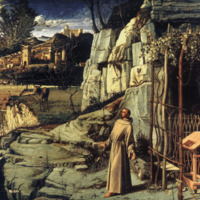


Bellini's landscapes were novel in conception, as artists before him did not utilize natural topography in a way that it could begin to be categorized as its own genre. In Bellini’s paintings the landscape is as much the protagonist as is the religious subject [1]. His landscapes reflected Venice’s natural physical features, he set his works into a reality of lived experience. Sophisticated patrons were the majority of Bellini’s commissioners, it was often times the Scuole who requested the works of Bellini’s. This influenced his masterful depictions of religious matter set in evocative landscapes of Venice as seen in all three of his works shown here: St. Francis, St. Jerome Reading, and Madonna and Child in Landscape.
St. Francis, a notable work of Bellini, best depicts the way in which Bellini had his figures interacting with their setting. Often using smaller figures in comparison to the overall composition, like St. Francis in St. Francis, this careful relationship created a mood of spirituality and a landscape of quiet religiosity [2]. Not only does Bellini make use of the natural topography but also of the natural light that adds to the overall serene ambience of the painting. St. Jerome Reading uses this same style to create a very similar theme, an emphasis on the nature surrounding the saint in a moment of spiritual ecstasy. Madonna and Child in a Landscape follows this style again and provides further evidence to Bellini’s masterful use of natural light to highlight the religious figures that are the main subject matter. His use of natural light and work with landscapes was unprecedented in this era, he was responsible for setting the ground work for his great pupils, Titian and Giorgione.
1.“The Getty Museum,” Getty Museum, accessed November 16, 2020, http://www.getty.edu/art/exhibitions/bellini/index.html.
2. Warren D Tresidder, “THE DEVELOPMENT OF LANDSCAPE IN VENETIAN RENAISSANCE PAINTING 1450 - 1540,” 1964, 3.