Gallery 3 - The Landscape's of Giorgione
Giorgione’s life was short, along with the list of paintings that can be affirmed to be by Giorgione. Although he lived a short life, his accomplishments were vital enough to establish him as a large influential figure in the history of Western art. Not enough documentation has been discovered to record his patron's demands, the meanings of his works have always been subject to fervent conjecture. The enigmatic nature of his paintings does not stain his importance in the development of the landscape as a distinct genre, some historians have argued that his work was what led to this development of landscape as a genre in its own right [1].
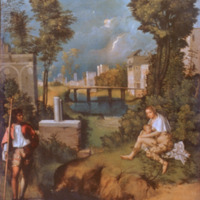
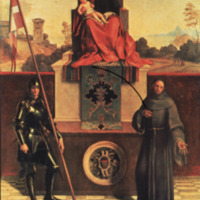
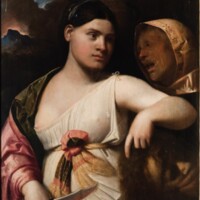
Giorgione’s landscapes include a soft atmosphere that unifies landscape and figures. The forms in his works are gentle and appear slightly blurred in the contours of the land, the rustic countryside is a primary feature in the majority of Giorgione works. Bellini’s work is composed entirely of religious matter, while Giorgione was motivated by the new humanist culture blossoming in the late fifteenth and early sixteenth century [2]. This allowed for the human figures to be completely integrated into the landscape, the figures sometimes being smaller and less important than the background itself, as seen in The Tempest. The subject of this painting has been largely debated and remains a mystery, however the lack of storyline for the figures gives The Tempest a true landscape experience. The broad countryside behind the Virgin Mary and Christ in the Castelfranco Madonna again shows the Arcadian nature of Giorgione’s backdrops. Seen in Judith is the Giorgionesque soft countryside and the background with hazy contours and ill-defined structures. Giorgione’s landscapes, although few in number, were a crucial influence on the development of landscapes into a defined artistic genre.
1. “Giorgione Paintings, Bio, Ideas,” The Art Story, accessed November 17, 2020, https://www.theartstory.org/artist/giorgione/.
2. Warren D Tresidder, “THE DEVELOPMENT OF LANDSCAPE IN VENETIAN RENAISSANCE PAINTING 1450 - 1540,” 1964, 5.