Power Expressed through Secular Art and Portraiture
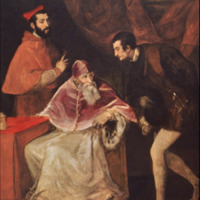
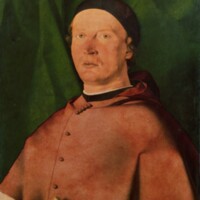
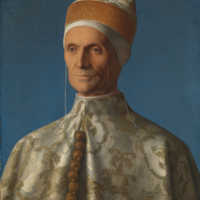
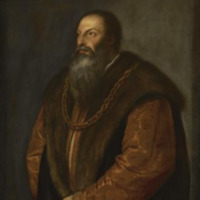
Individuals often promoted their self image through portraiture, which––no matter where it was displayed––would allow an impressionable reception. Posture, clothing, orientation, and lighting among many other details were not left to chance but rather skillfully crafted by the artist to send a particular message. Politicians, artists, and religious figures all took advantage of the medium. Notably, these paintings would outlast the subject and therefore carry on his or her legacy through time.
Most clearly, we see this through Titian’s 1545 Pope Paul III with his Grandsons in the Museo di Capodimonte (Fig. 8). Here, the Pope––the elected head of the Catholic Church––establishes a line of succession and the continuation of the power of his family through his grandchildren. He also informs us and all future generations (both family and not) of his own legacy and wisdom. Similarly, Lorenzo Lotto was commissioned in 1505 to paint the Portrait of Bishop Bernardo de’ Rossi, which was intended to showcase the subject's high social and political status within the church and now hangs in the Museo del Prado (Fig. 9). Although Lotto attempted to humanize him, de’ Rossi’s intent was to further his own power through this narrative work.
Doge Leonardo Loredan (the leader of Venice) had a similar idea when soliciting a portrait from Giovanni Bellini self-titled Doge Leonardo Loredan (now in the National Gallery of Art in London) (Fig. 10). It was meant to hang in the Council Room of the Palazzo Ducale and modeled after busts of Roman emperors, thus making a connection between them and their authority to that of Loredan. Furthermore, it expresses through its details his intelligence, humanity, and wealth. In Titian’s 1537 Pietro Aretino in the Frick Collection, we add to this theme (Fig. 1). Aretino, a prominent Italian writer and scheming political operative, displayed his influence in commissioning an artist with the reputation of Titian for his self-portrait. To all of its viewers, including the wealthy banker Cosimo de’ Medici, he could display his immense riches and power.
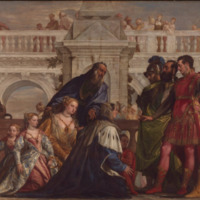
Just like with religious art, families could also commission works––sometimes allegorical although still secular in nature––to promote a certain image of themselves. An example of this is The Family of Darius before Alexander by Paolo Veronese from 1565 in the National Gallery of Art in London (Fig. 11). Not only does it show off the power of Venice and its commissioning family––the Pisanis––in relation to the might of Greece, it allows Veronese to flex his personal abilities as a painter to attract future commissions.