Power Expressed through Religious Painting
Religious paintings are very common in the realm of Venetian committed art. Part of the reason for this is the way that Venice viewed itself. Not only did it portray itself as one of the most pious if not the most pious city in the Catholic world––surmounting even the papacy in Rome––it sculpted the image that it was the natural successor to Byzantium and therefore the Roman empire. This idea was constantly promoted through association with religious symbols from both belief systems.
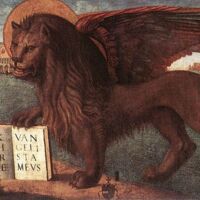
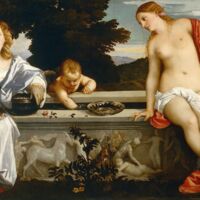
At the individual level, we can see countless examples of the projection of power through painting. One such work is Vittore Carpaccio’s 1516 The Lion of St. Mark, which currently resides in the Palazzo Ducale in Venice (Fig. 2). The monumental piece originally hung in the Palazzo dei Camerlenghi. Tying in the Republic’s sacred protection from its patron St. Mark and associating it directly with the city (which can be seen behind it) and the family (whose coat of arms is clearly visible), it makes a statement about the immense wealth and influence of the Camerlenghis. This was on display to every visitor who entered the palace. Another example can be seen in Titian’s Sacred and Profane Love in the Galleria Borghese in Rome (Fig. 3). Painted in 1514 to celebrate the marriage of a Venetian statesman, it reminds all onlookers of the couple’s fidelity towards each other and to the city of Venice, reaffirming their connection to it.
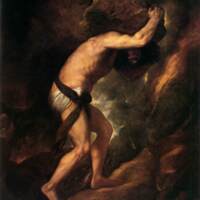
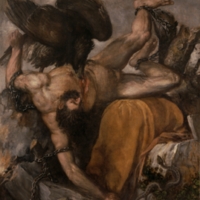
Individuals outside of the Republic also took advantage of this political tool. Mary of Hungary commissioned Titian, one of the most famous Venetian painters, to create a series depicting Greek myths about punishment. Two of these, Sisyphus (from 1548) and Tityus (from 1565) now hang in the Museo del Prado in Madrid, but once were featured in her Great Hall (Fig. 4. And Fig. 5). Together, they showed the consequences associated with challenging her authority and resisting her justice.
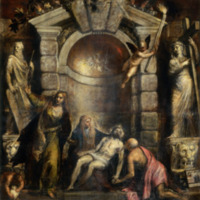
In some cases, artists promoted themselves through their art. In 1576, Jacopo Palma Giovane attempted to establish himself as the heir to Titian’s greatness when he completed his unfinished piece Pietà (Galleria dell’Accademia)––even going as far as inscribing his name on the bottom (Fig. 6).
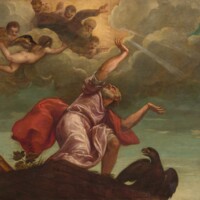
Committed religious art, however, was not limited to just individuals. Groups such as the Scuola di San Giovanni Evangelista commissioned works like Titian’s 1547 Saint John the Evangelist on Patmos (now in the National Gallery of Art) to cement their status as one of the five scuola grandi (large lay confraternities) of Venice. It also strengthened their connection to God and their patron saint Saint John (Fig. 7).