Gallery 3: Physical Ideals of Venetian Women
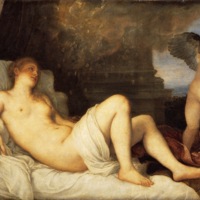
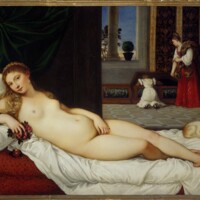
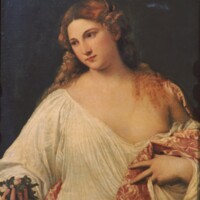
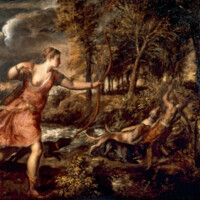
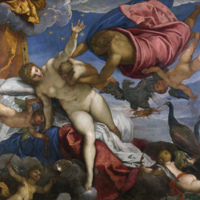
Venice also stood apart from other cities because they believed that their city-state had a female personification – thus, we will see Venice was frequently referred to with "she/her" pronouns. While many other Italian cities are also feminine, Venice truly developed this role in spectacular artwork. Furthermore, many of the divine protectors of the city were female, serving as female personifications of the traits of justice, power, progress, loyalty, and intelligence [1]. These divine protectors were visualized through an idealized phsyical form, that artists, including Titian and Tintoretto, whose work we will exmaine in this gallery, used to represent women in their paintings. These women were painting in a very similar way to the female representation of Venice, beautiful, serene, and majestic, with a divine aura – lighter coloring, a halo-like light around the head, or a central focus in the painting itself.
While we will examine works of art predominantly by Titian, he was a key influence on various other painters in terms of female figures, and thus we can recognize that many other artists had very similar interpretations and physical features in their work. Titian and Tintoretto both took traditional mythological allegories, and modified the figures to fit into the Venetian ideal of female beauty – fair skinned, light haired, rosy cheeks and delicate facial features, with a larger but soft build. This visualization of women allowed Venetians to construe female figures in traditional maternal and feminine societal duties, while simultaneously possessing the coveted qualities of strength and power held by Venice herself.
[1] Monica Chojnacka, Women of Early Venice, Johns Hopkins University Press, 118-121.