Gallery 1: Influences on Mythological Storytelling
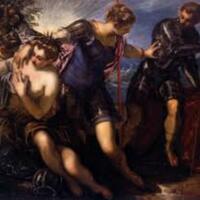
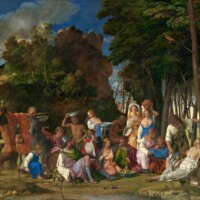
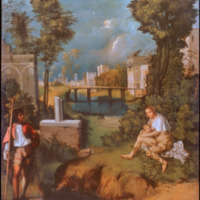
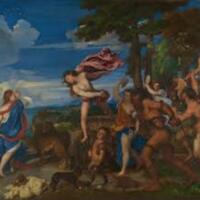
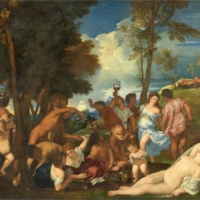
To fully understand and appreciate the interpretation of classical mythology by Venetian painters, we must explore the techniques, both new and old, that these Venetian painters used to convey and emphasize their messages. The artists in this gallery were leaders in the field of painting, with intricate skills that ultimately contributed to the creation of mythological paintings that advanced them from their original meaning to works of art that promoted Venetian ideals while simultaneously telling their stories.
While in future galleries, we will see many works of Titian, we must also recognize artists including Tintoretto, Bellini, and Giorgione. Titian was well-known for his allegorical theme paintings, and his ability to convey emotion and dynamic scenes through his use of detail. In this gallery, we will examine two of Titian’s mythological works of art, Bacchus and Ariadne, and Bacchanal of the Andrians, both of which use specific style and technique to encompass the spectacle. Tintoretto was greatly accomplished in the creation of mythological allegories. Around 1575, he completed four of these allegories for the Doge’s Palace – extraordinarily well-executed paintings that showcased detail in both his personal ideologies and faith [1]. The painting in this gallery, Minerva Sending Away from Peace and Prosperity, is part of the four painting series and is very crucial to understand Venetian techniques particularly around light and colors. Similarly, Bellini throughout his lifetime evolved from simple religious, narrative paintings, to an emphasis on setting and landscape that conveyed deep emotion through the allegories [2]. Bellini and Titian worked together on The Feast of the Gods, in this gallery, and is meant to convey several Venetian ideals through the gods portrayed, and the ways in which they are characterized. Finally, Giorgione was greatly influenced by Bellini, studying under him as a young artist, and then matured these elements into a unique, modern style [3]. While the painting in this gallery by Giorgione, The Tempest, is not necessarily a Greco-Roman mythological allegory, Giorgione was a key influence in the use of landscape and naturalism to evoke literary themes, ultimately developing how other artists told stories [4]. Throughout the exhibit, we will examine various other artists not mentioned here as well, but who use similar techniques, and who were influenced by these four prominent artists.
[1] Rodolpho Pallucchini, "Tintoretto", Encyclopedia Britannica, https://www.britannica.com/biography/Tintoretto.
[2] Thomas Nichols, "Bellini", Encyclopedia Britannica, https://www.britannica.com/biography/Gentile-Bellini.
[3] Harold E. Wethey, "Giorgione", Encylcopedia Britannica, https://www.britannica.com/biography/Giorgione.
[4] Cecile Gould, "The Tempest", Encyclopedia Britannica, https://www.britannica.com/The-Tempest.